What does distillatory mean?
Distillatory is a formal adjective meaning relating to or used in distillation—the process of heating a liquid to create vapor and then condensing that vapor back into a purified form. It typically modifies nouns such as apparatus, vessel, furnace, or flask, as in 'a distillatory apparatus,' and appears most often in technical writing and in historical accounts of alchemy and early chemistry, when practitioners relied on elaborate glassware and furnaces to extract essences, spirits, and medicines. Less commonly, distillatory serves as a noun naming the vessel or apparatus itself, though this sense is now largely confined to antiquarian literature. The word derives ultimately from the Latin destillare, 'to drip down,' the same root that gives us distill and distillation. Because it sounds similar to distillery—a place where distilling happens—careful writers distinguish the two: one is a descriptive adjective, the other a location. In modern usage, simpler phrases like 'distilling equipment' have largely displaced it outside scholarly contexts.
A vessel or piece of apparatus used in distilling liquids.
"The old manuscript included diagrams of every distillatory needed to prepare the herbal essence."
This nominal sense is rare today and found mostly in historical or scholarly writing about alchemy and early chemistry.
Relating to or used in distillation.
"He inspected the distillatory apparatus before starting the experiment."
Applies only when distillatory functions as a noun meaning a distilling vessel; such uses are rare and largely historical.
"The apothecary's workshop was filled with retorts, alembics, and other distillatories."
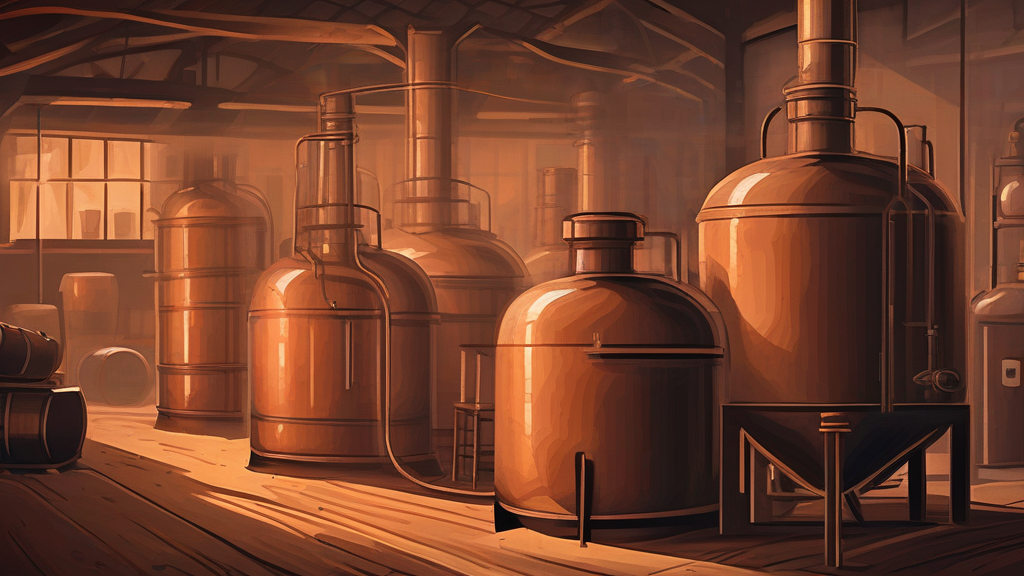
Long before modern chemistry had its labs, alchemists relied on their trusty distillatory vessels to chase everything from spirits to the philosopher's stone.
Reviewed by Deb Chak, Editor. AI-assisted content curated by RJS Tech Solutions LLP.
Etymology of distillatory
Distillatory comes from the Latin verb destillare (also spelled distillare), meaning 'to drip down' or 'to trickle drop by drop,' formed from the prefix de- ('down') and stillare ('to drip'), which itself relates to stilla, 'a drop.' English adopted the word in the early modern period alongside the rise of alchemy and chemical practice, forming it with the adjectival suffix -ory to describe things pertaining to the distilling art. It shares this root with distill, distillation, distiller, and the noun still, all tracing back to the same Latin source.
How distillatory is actually used
Distillatory is chiefly a formal or technical adjective, encountered most often in historical texts on alchemy and early chemistry, and in descriptions of laboratory apparatus. It is uncommon in everyday speech, where phrases like 'distilling equipment' are preferred. As a noun it survives mainly in antiquarian or scholarly contexts.
Easily confused with distillatory
A distillery is a place or premises where distillation is carried out (such as a whisky distillery), whereas distillatory is an adjective describing anything pertaining to the process or apparatus of distilling.