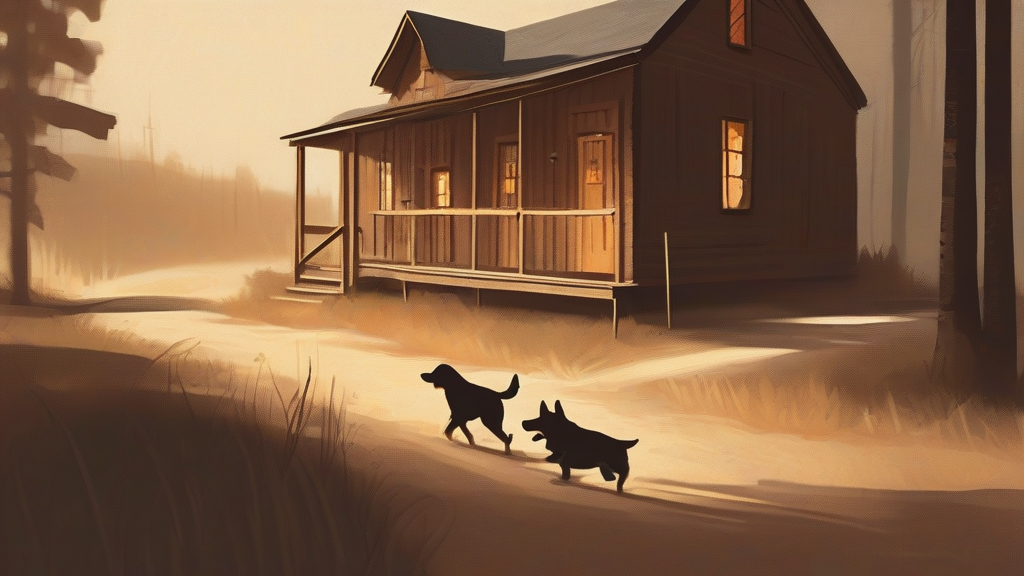
What does dogtrot mean?
A dogtrot is a steady, easy running pace resembling the natural gait of a dog — quicker than a walk but more relaxed than a gallop. The word is applied most often to horses, mules, or people who settle into this economical, loping rhythm, especially in rural, equestrian, or historical contexts. In the American South, the term took on a second life in architecture: a dogtrot house is a traditional vernacular dwelling made of two enclosed rooms joined by an open, roofed central passage known as a breezeway. This design promoted ventilation before air conditioning, and the passage became a favorite shady resting spot for dogs — hence the name. Whether describing movement or buildings, dogtrot carries connotations of practicality, endurance, and unpretentious country life, making it a vivid word for writers evoking rural landscapes or historic Southern architecture.
A steady, easy trotting pace like that of a dog's natural running gait.
"She urged her mule into a dogtrot and let him set the pace along the trail."
Often used with verbs such as 'settle into', 'hold', or 'break into', and typically implies sustained, economical movement rather than speed.
In the American South, a style of house consisting of two enclosed rooms joined by an open roofed central passageway (breezeway) under one continuous roof.
"The museum preserved an original dogtrot, complete with its shaded central hallway."
Also called a 'dogtrot house' or 'dog-run house'; the term is strongly associated with Southern vernacular architecture of the eighteenth and nineteenth centuries.
The plural is rare in ordinary prose; it usually appears when referring to multiple dogtrot houses or to repeated stretches of the gait.
"Several original dogtrots survive along the historic byway."
In the old American South, a 'dogtrot' wasn't just a gait — it was an entire style of house built with a breezeway down the middle, so named because dogs loved to nap in its shade.
Reviewed by Deb Chak, Editor. AI-assisted content curated by RJS Tech Solutions LLP.
Etymology of dogtrot
Dogtrot is a straightforward English compound formed from 'dog' and 'trot', first recorded in American English around the early nineteenth century to describe the dog's characteristic running gait. The element 'trot' derives via Middle French 'troter' from Old French, ultimately of Germanic origin, giving English related forms such as 'trotter'. The compound was extended figuratively to any similar easy pace, and in the nineteenth-century American South it was applied to the breezeway-style log house whose open central passage invited canine occupants.
How dogtrot is actually used
The gait sense is used mainly in descriptions of horses, mules, or people moving at an unhurried but brisk pace, often in rural or historical writing. The architectural sense is firmly regional to the American South and appears frequently in discussions of vernacular or historic architecture. Both senses are somewhat informal or specialized rather than part of everyday urban vocabulary.
Easily confused with dogtrot
A jogtrot is the bouncy, jolting pace of a horse ridden without proper posting, while a dogtrot is specifically the smooth, natural running gait of a dog.
Doggo is informal slang meaning to stay hidden or out of sight, whereas a dogtrot is a pace of movement or a style of house.