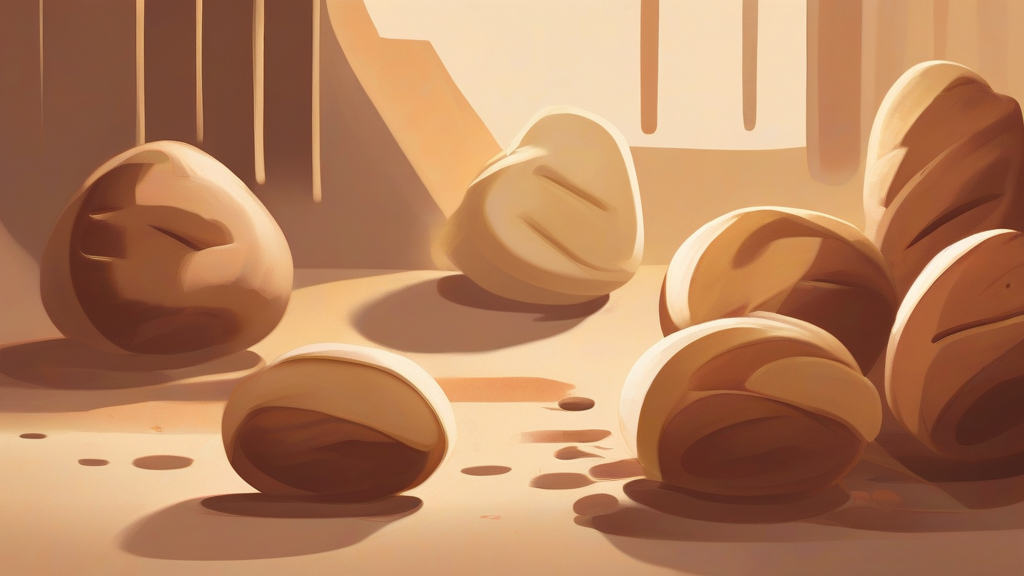
What does doughier mean?
Doughier is the comparative form of the adjective 'doughy', meaning more like dough in texture: softer, denser, heavier, and typically undercooked. It appears most often in discussions of baking and cooking, where a bread, cake, or pastry may be judged doughier than intended if its interior has not fully set or browned. The word can also describe human flesh or features that seem pale, soft, and lacking firmness, though this use is less frequent and tends toward the unflattering. Derived from 'dough' — the mixture of flour and liquid used in baking — via the Middle English 'dough' from Old English 'dāh', the word belongs to an old Germanic family of terms for paste-like mixtures. Whether evaluating a loaf's crumb or a character's complexion, 'doughier' offers cooks and writers a precise way to signal excess softness where firmness was expected.
adjective (comparative of 'doughy')More doughy; having a soft, heavy, and often undercooked or dense texture, like that of dough. Also used figuratively to describe a face or flesh that is pale, soft, or flaccid.
- Having the texture of raw or undercooked dough; soft, dense, and heavy.
- (of skin or flesh) Pale, soft, and lacking firmness or tone.
"The middle of the loaf was still doughier than the crisp, golden crust around it."
"She pulled the rolls out early, so they were doughier than she'd hoped."
"The portrait captured his doughier cheeks, softened by years of comfortable living."
Bakers dread it, bread judges penalize it — but a doughier center is exactly what you want in a good cookie.
Reviewed by Deb Chak, Editor. AI-assisted content curated by RJS Tech Solutions LLP.
Etymology of doughier
Doughier derives from 'doughy', an adjective formed from 'dough', which comes from Old English 'dāg' or 'dāh', meaning a moistened mass of flour. The Old English term traces back through Proto-Germanic roots shared with Dutch 'deeg' and German 'Teig'. The comparative suffix '-ier' follows the standard pattern for two-syllable adjectives ending in -y, replacing the y with i before adding '-er'.
How doughier is actually used
Informal to neutral in register. Most commonly used in cooking and baking contexts to describe undercooked bread, pastry, or baked goods; the figurative sense describing pale, flabby flesh is less common and can carry a mildly unflattering connotation.
Easily confused with doughier
'Dourer' is the comparative of 'dour', meaning more stern or gloomy, while 'doughier' means more soft and dough-like in texture.