What does downland mean?
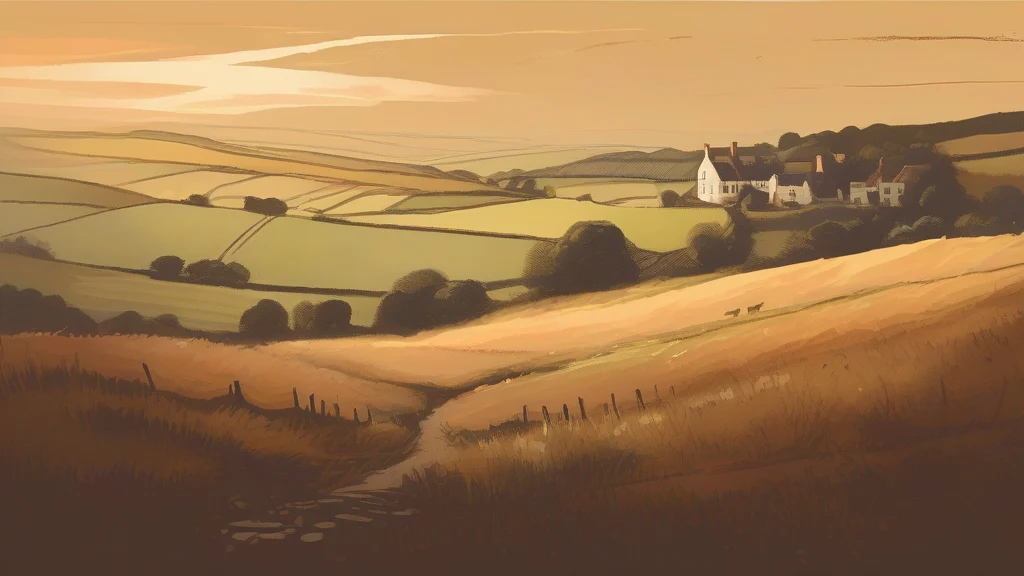
Downland is a noun denoting rolling, open upland country, most characteristically the chalk grasslands of southern England, as in the North and South Downs. Despite containing the word 'down', it refers to high rather than low ground — a legacy of Old English dūn, meaning hill, which also survives in 'dune'. The term is chiefly British in everyday use and evokes a distinctive landscape of treeless, gently undulating hills covered in turf and wildflowers, much of it protected for its ecological value. It appears frequently in descriptions of countryside, walking routes, and nature writing, often paired with 'chalk' as in 'chalk downland'. For readers and writers describing British rural scenery, downland is the precise, evocative term for this particular kind of elevated grassland terrain.
nounRolling open upland country, especially chalk grassland such as that found in southern England; used especially in the names of areas like the Sussex Downs and the North and South Downs.
- Open rolling upland country, typically chalk grassland, especially in southern England.
"They spent the morning walking the chalk downland above the village."
"The trail climbed steadily across the open downland."
"Chalk downland supports rare wildflowers found almost nowhere else in Britain."
The plural is used when referring to multiple such areas or stretches of upland country.
"The chalk downlands of Wiltshire are rich in archaeological sites."
In southern England, going 'down' often means climbing up — the famous Downs are hills, a survival of an Old English word for high ground.
Reviewed by Deb Chak, Editor. AI-assisted content curated by RJS Tech Solutions LLP.
Etymology of downland
Downland derives from Old English dūn, meaning 'hill' or 'upland', combined with 'land'; the same Germanic root gives modern 'dune', borrowed via Middle Dutch. In English place-names and common nouns the old sense of dūn survives in the Downs, the chalk hill ranges of southern England, which is why 'down' can paradoxically mean an elevation. The compound downland arose to describe this kind of upland terrain, and remains closely tied to British geography.
How downland is actually used
Chiefly British, and strongly associated with the chalk hills of southern England; it carries pleasant connotations of open countryside, walking, and pastoral landscape.
Easily confused with downland
"Downfall" means a loss of power or ruin, while "downland" refers to rolling upland country.
"Lowland" denotes flat or low-lying ground, whereas "downland" refers to elevated open hill country despite the word "down".