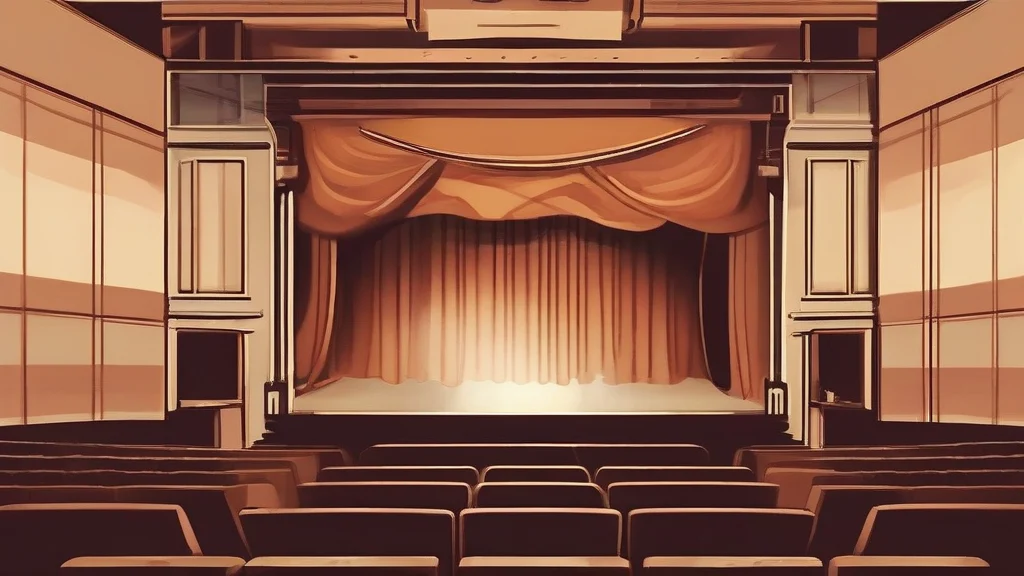
What does downstage mean?
Downstage refers to the front portion of a theater stage — the area nearest the audience. The noun names that physical space, while the adverb describes movement toward it: an actor may be told to walk downstage so their face and gestures are clearly visible. The term dates from the era of raked stages, which sloped downward toward the auditorium, making the front literally lower than the back; even after flat staging became standard, the vocabulary endured. Directors and stage managers use downstage constantly when giving blocking instructions, often refined as downstage left, right, or center. Its natural opposite is upstage, the rear of the stage. Though rooted in professional theater practice, the word is broadly understood and occasionally appears figuratively to suggest stepping into the spotlight or claiming prominence before an audience.
The front part of a stage, closest to the audience.
"The props were stacked just off the downstage edge."
Frequently combined with left, right, or center for precise positioning.
Toward or at the front of the stage.
"She moved downstage to make her whisper audible in the back rows."
Rarely used in the plural; the word normally appears in the singular since a stage has one downstage area.
"The touring production played venues with very different downstages."
In Shakespeare's day stages raked upward away from the crowd — so walking 'down' the boards literally meant heading toward the audience, and the name stuck.
Reviewed by Deb Chak, Editor. AI-assisted content curated by RJS Tech Solutions LLP.
Etymology of downstage
Downstage derives from the English compound of 'down' plus 'stage', arising in the nineteenth century from the practice of building stages on a rake — an incline rising away from the audience. Moving toward the audience meant moving literally downhill, hence 'downstage'; its counterpart 'upstage' was formed on the same model. Both terms survived the disappearance of raked stages and remain standard theatrical terminology today.
How downstage is actually used
Primarily theatrical jargon, though well understood by general audiences. Often paired with left, right, or center to give precise blocking directions. The related adverb 'upstaging' someone has taken on a figurative meaning — drawing attention away from another performer — but 'downstaging' has no such figurative use.
Easily confused with downstage
Downstage is the part of the stage nearest the audience, while upstage is the part farthest from it.