
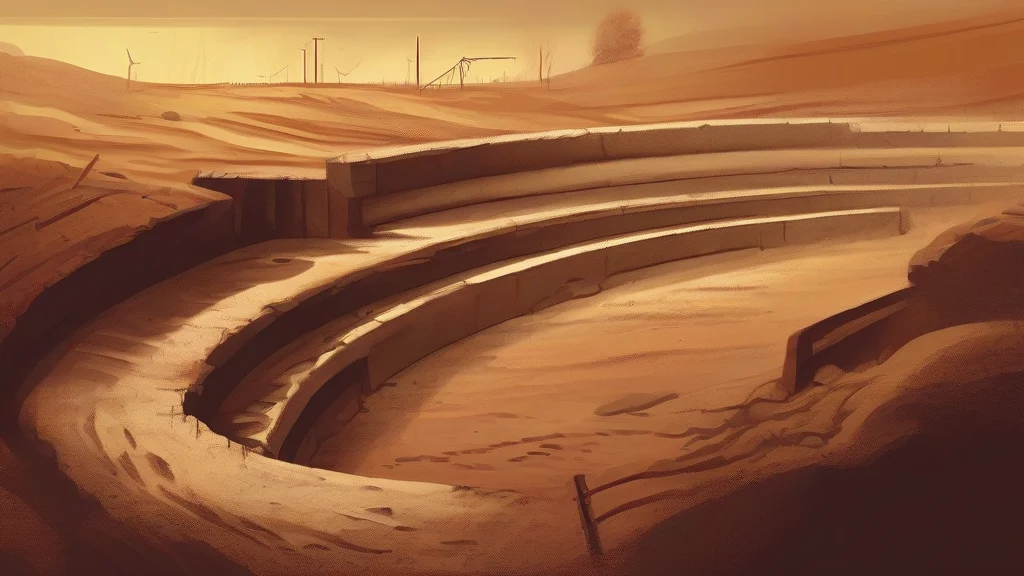
What does earthwork mean?
An earthwork is a structure made by shaping or piling up earth — typically a bank, mound, rampart, ditch, or embankment. The word is most familiar from archaeology and military history, where earthworks denote defensive constructions built without masonry: hillfort ditches, siege trenches, battlefield entrenchments. It also has a precise meaning in civil engineering, where earthworks cover the excavation and embankment work involved in building roads, railways, canals, and dams. Because such structures are formed from compacted soil rather than durable materials, they erode over time, so surviving ancient earthworks are prized evidence of prehistoric settlement and organisation — sites like Maiden Castle in Dorset or the Great Serpent Mound in Ohio consist almost entirely of earth shaping. The noun is countable, takes the standard plural "earthworks", and appears chiefly in formal, academic, or technical prose rather than everyday conversation.
nounA rampart, embankment, or other construction made of earth, especially one used as a fortification. More broadly, any engineering structure formed by moving and shaping large quantities of soil.
- A mound, bank, rampart, or ditch made of earth, especially as a defensive fortification.
- An embankment or cutting made of earth in civil engineering, such as for roads, railways, or canals.
"Archaeologists uncovered the remains of an Iron Age earthwork on the hilltop."
"The soldiers threw up hasty earthworks to protect their position along the ridge."
"The new railway line required extensive earthworks through the valley."
Regular plural; the plural is especially common when describing multiple banks, trenches, or embankments forming a single defensive system.
"The Civil War earthworks surrounding the town remain remarkably well preserved."
Some of Britain's oldest monuments aren't buildings at all — they're earthworks like Maiden Castle, whose banks and ditches were shaped by hand over two thousand years ago and still stand today.
Reviewed by Deb Chak, Editor. AI-assisted content curated by RJS Tech Solutions LLP.
Etymology of earthwork
Earthwork is a straightforward English compound of "earth" (from Old English eorþe) and "work" (Old English weorc), both native Germanic words. It emerged in English usage around the late sixteenth century, when gunpowder warfare made massive earthen ramparts and bastions more practical than stone walls. Its Germanic roots make it unrelated to the Latin-derived vocabulary common in architectural terms; related compounds include earthquake, earthenware, and earthbound.
Related word forms
How earthwork is actually used
Most often used in the plural ("earthworks") when referring to military or archaeological fortifications. The word has a formal, technical register, appearing mainly in archaeology, history, military writing, and civil engineering.
Easily confused with earthwork
"Earthmoving" refers to the activity of excavating or relocating soil with machinery, while an "earthwork" is the resulting earthen structure itself.
"Artwork" means works of art such as paintings or sculpture; it resembles "earthwork" in form but has nothing to do with soil — though "land art" is sometimes called earth art.