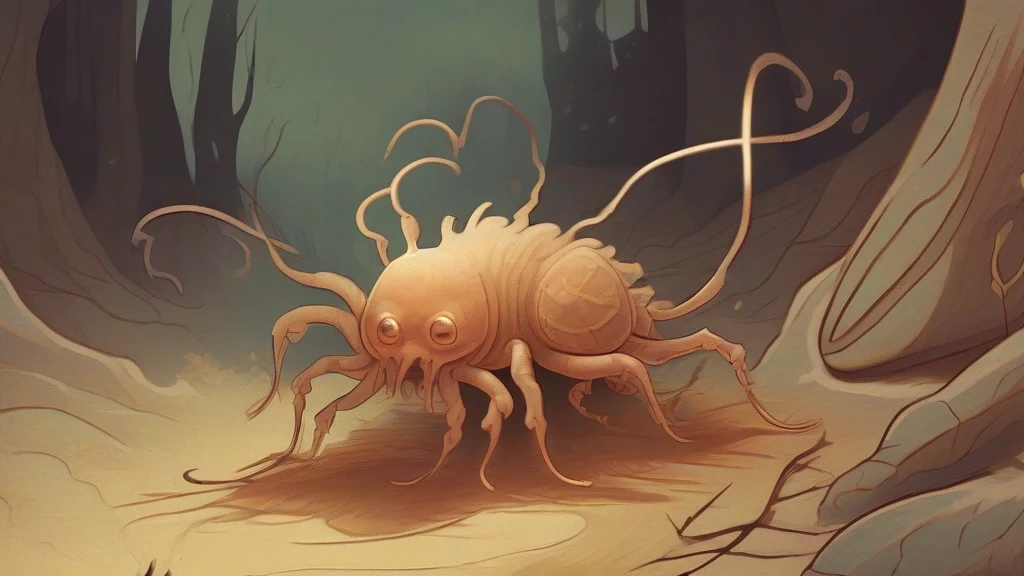
What does ectozoon mean?
An ectozoon (plural ectozoa) is an animal that lives as a parasite on the exterior of another organism, its host. Familiar examples include lice, fleas, ticks, and mites, which attach themselves to the skin, hair, or feathers of mammals, birds, and other animals to feed on blood, skin debris, or secretions. The term comes from Greek roots meaning 'outside' and 'animal,' and it stands in direct contrast to entozoon, a parasite dwelling within the body, such as a tapeworm. Ectozoon belongs chiefly to the vocabulary of zoology, parasitology, and veterinary science, so ordinary readers will more often meet its practical synonym, ectoparasite. The word remains useful, however, whenever precision matters: distinguishing surface-dwelling parasites from internal ones shapes how infestations are diagnosed and treated, whether on livestock, pets, or humans.
nounAn animal parasite that lives on the outside of the body of its host, such as a louse, tick, flea, or mite.
- An animal parasite that lives on the outer surface of its host's body.
"The veterinarian examined the dog's coat for any sign of an ectozoon before prescribing treatment."
"Lice are among the most familiar ectozoa afflicting schoolchildren."
"A single ectozoon, the sheep tick, can transmit several serious diseases to livestock."
The plural follows the Greek-style pattern "ectozoa," standard in zoological literature; the anglicized "ectozoans" is also acceptable in less formal contexts.
"The hides were inspected carefully for ectozoa before export."
The word 'ectozoon' literally means 'outside-animal' in Greek — a perfect label for freeloaders like ticks and lice that set up house on your skin.
Reviewed by Deb Chak, Editor. AI-assisted content curated by RJS Tech Solutions LLP.
Etymology of ectozoon
"Ectozoon" derives from the ancient Greek prefix ekto-, meaning 'outer' or 'external' (from ektos, 'outside'), combined with zōion, meaning 'animal.' The same zōion root gives English a wide family of scientific terms including protozoan and zoology, while the ekto- element appears in words such as ectoderm. The term was coined in the context of nineteenth-century natural history to classify parasites by their position relative to the host, pairing it with the parallel formation entozoon for internal parasites.
Related word forms
How ectozoon is actually used
"Ectozoon" is a technical term used mainly in zoology, parasitology, and veterinary medicine; in general contexts "ectoparasite" is far more common. It is a formal register word and rarely appears in everyday speech.
Easily confused with ectozoon
An entozoon is a parasite that lives inside the host's body (such as a tapeworm), whereas an ectozoon lives on the external surface.