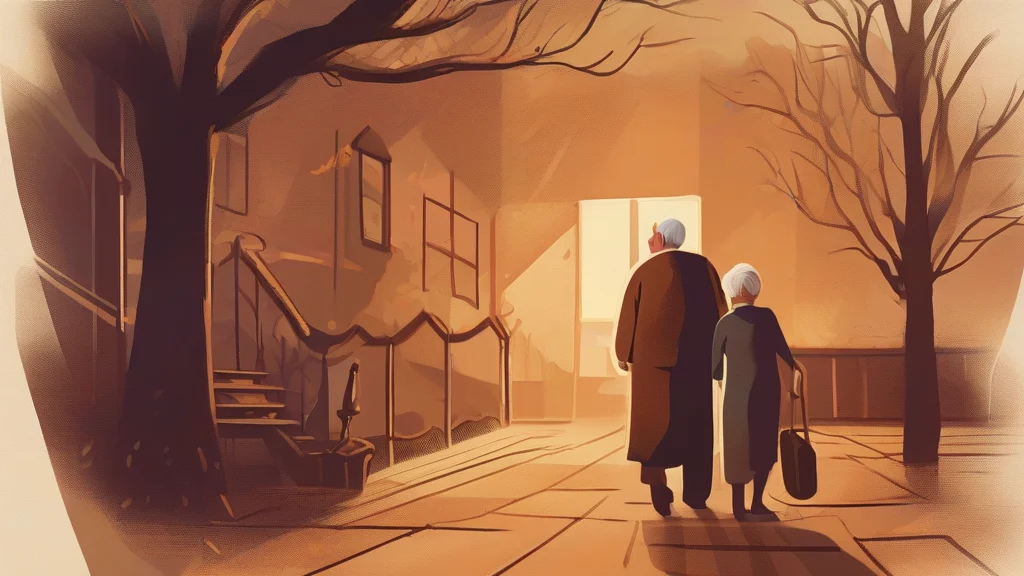
What does elderly mean?
"Elderly" is an adjective used to describe people who are fairly old, typically those past middle age. It functions largely as a courteous alternative to plainer words like "old", softening the description out of respect for its subject. One might refer to an elderly neighbour, an elderly gentleman, or elderly patients, and the term appears constantly in contexts involving health, housing, transport, and social care. It can also serve as a collective noun — "the elderly" — meaning old people considered as a group, as in priority seating reserved for the elderly. The word carries a generally respectful, neutral tone, though some contemporary writers prefer phrases such as "older adults" in formal usage. Derived from the comparative "elder" plus the suffix "-ly", it literally suggests being somewhat further along in age. Because ageing touches nearly every area of public life, "elderly" remains one of the most useful and frequently encountered words for discussing later life with tact.
(Of a person) fairly old; past middle age, especially when described in a polite or tactful way.
"She devoted her weekends to visiting elderly neighbours who lived alone."
Applies almost exclusively to people, not objects or animals. Increasingly, style guides recommend alternatives such as 'older adults' in formal writing.
Used with 'the': old people considered collectively as a group.
"The city has expanded its services for the elderly."
Always preceded by 'the' and treated as plural: 'The elderly are at greater risk.'
"Elderly" was originally just "elder" plus the adjective-making suffix "-ly" — literally meaning "somewhat more old" — and it remains one of English's most tactful ways to say someone is getting on in years.
Reviewed by Deb Chak, Editor. AI-assisted content curated by RJS Tech Solutions LLP.
Etymology of elderly
The word "elderly" was formed in English from "elder" — the comparative of "old", descending from Old English "eald" — combined with the adjectival suffix "-ly", giving it the literal sense of being somewhat more old. It emerged in the early 17th century and gradually settled into its modern role as a polite descriptor for advanced age. Its root connects it to a small family of Old English words including "elder", "eld" (meaning old age), and ultimately "alderman", historically an elder or senior member of a community.
How elderly is actually used
Considered a polite, tactful alternative to 'old' when describing people, though some now prefer terms like 'older adults' or 'seniors' in formal or institutional writing. It normally applies to people rather than things. When used as a noun ('the elderly'), it takes plural agreement: 'The elderly are particularly vulnerable.'
Easily confused with elderly
'Elder' means older (often of two people, especially within a family) or a person of senior status, while 'elderly' simply describes someone as fairly old.