What does empanada mean?
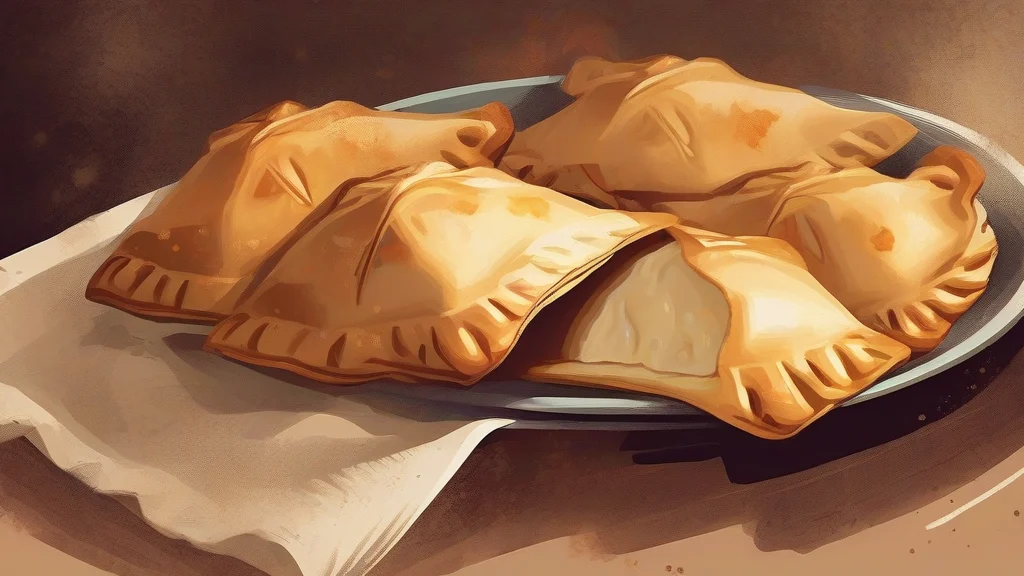
An empanada is a pastry turnover originating from Spain and widely adopted throughout Latin America, made by folding a thin dough around a savoury filling and sealing the edges before baking or frying. Typical fillings include seasoned ground beef, chicken, cheese, vegetables, or seafood, often flavoured with onions, spices, and herbs. The word comes from the Spanish verb empanar, meaning to coat or wrap in bread, reflecting the dish's essential character as a self-contained, portable meal. Empanadas are deeply embedded in everyday eating across Argentina, Chile, Colombia, Mexico, Spain, and many other regions, each with its own preferred fillings, shapes, and cooking methods; they appear at street stalls, bakeries, family gatherings, and celebrations alike. In English, the term is fully established and simply pluralizes as empanadas. The word is useful both as a culinary label and as a window into the rich tradition of filled pastries found around the world.
nounA pastry turnover of Spanish and Latin American origin, consisting of a folded dough shell filled with seasoned meat, cheese, vegetables, or seafood, then baked or fried.
- A folded pastry turnover filled with meat, cheese, vegetables, or seafood, baked or fried, common in Spanish and Latin American cuisine.
"She bought a warm beef empanada from the food stall outside the market."
"At the festival, vendors sold everything from spicy chorizo empanadas to sweet apple-filled ones for dessert."
"Her grandmother's recipe for Argentine empanadas calls for a pinch of cumin and a hard-boiled egg in each filling."
Standard plural follows regular English rules by adding -s, despite the word's Spanish origin.
"The bakery sells freshly baked empanadas every morning."
The name literally means 'breaded' — from Spanish empanar, 'to wrap in bread' — making the empanada one of history's most portable meals.
Reviewed by Deb Chak, Editor. AI-assisted content curated by RJS Tech Solutions LLP.
Etymology of empanada
Empanada derives from the Spanish verb empanar, meaning to wrap or coat in bread, formed from the prefix en- (from Latin in-) plus pan, meaning bread, which traces back to Latin panis. The noun empanada is the feminine past participle of this verb, essentially meaning 'that which has been breaded or wrapped'. The word entered English through Spanish culinary influence, becoming common in American English during the twentieth century as Latin American cuisine spread. It shares its Latin root panis with related terms such as pantry (via French), companion (literally 'one who shares bread'), and the Spanish-derived panada, a thick bread-based soup.
Related word forms
How empanada is actually used
The word is fully naturalized in English and takes English pluralization (empanadas), though it retains its Spanish pronunciation. It is used neutrally across registers. Fillings and preparation vary widely by country — Argentina, Chile, Mexico, Spain, and the Philippines all have distinctive traditions — so speakers often specify the national style when discussing particular versions.
Easily confused with empanada
A pasty is a British Cornish baked pastry traditionally filled with beef, potato, and swede, whereas an empanada is a Spanish or Latin American turnover with a wider range of fillings.
A calzone is an Italian folded pizza dough typically stuffed with cheese and Italian ingredients, while an empanada uses a thinner pastry-style dough with Spanish or Latin American fillings.