What does enginery mean?
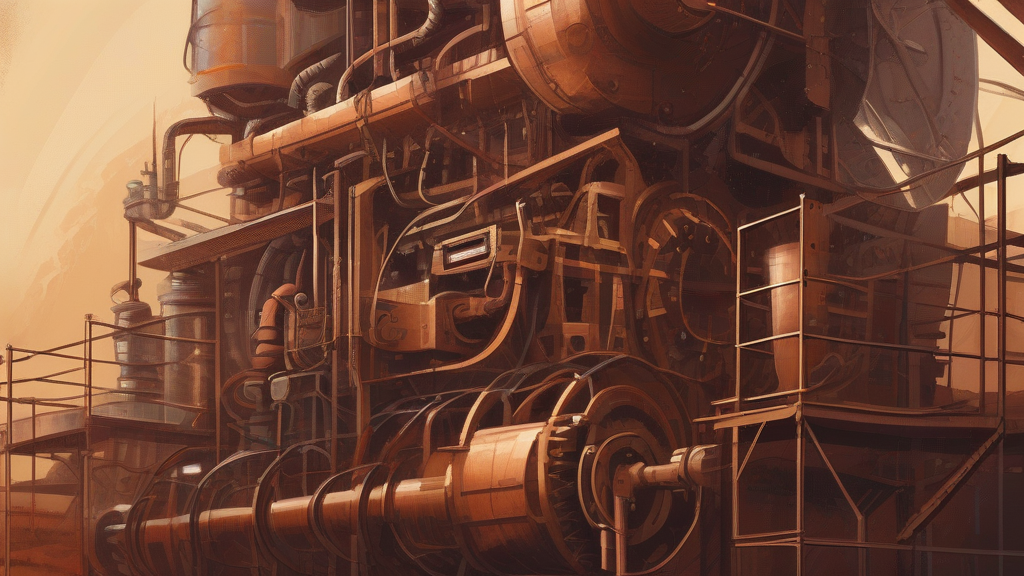
Enginery is a collective noun denoting machinery or mechanical apparatus, used especially of engines of war — cannon, siege engines, artillery, and other instruments of military engineering. Formed from engine with the suffix -ery (as in machinery and refinery), it entered English around the early seventeenth century and flourished in historical and military writing. Today it survives chiefly as a literary or archaic term: a writer describing a fortress battered by artillery might invoke its 'enginery of war,' lending the sentence a deliberately elevated, old-fashioned flavor. Beyond the battlefield, enginery can refer to any elaborate mechanical construction, and it occasionally appears in figurative use to characterize an intricate, impersonal system — industrial capitalism's enginery, for example. Because it overlaps closely with the common word machinery, enginery is best understood as a stylistic alternative: rarer, more resonant, and freighted with connotations of warfare, ingenuity, and the imposing scale of human contrivance.
nounMachinery or mechanical apparatus collectively, especially engines of war such as cannons and siege equipment; more broadly, any complex system of machines or engineered devices.
- Machines or mechanical devices collectively, especially engines of war (cannon, siege engines, artillery).
- By extension, any complex apparatus or ingenious mechanical construction; sometimes figuratively for an intricate system or scheme.
"The fortress walls had withstood centuries of sieges, but modern enginery reduced them to rubble in a single afternoon."
"The museum's collection includes the fearsome enginery of the medieval siege: trebuchets, battering rams, and mobile towers."
"In his later novels, the author described industrial society as vast enginery grinding up human lives in service of profit."
Long before 'military-industrial complex,' English speakers had a word for it: enginery — the whole thunderous apparatus of siege engines, cannon, and contrivances that decided the fate of fortresses.
Reviewed by Deb Chak, Editor. AI-assisted content curated by RJS Tech Solutions LLP.
Etymology of enginery
Enginery derives from the noun engine combined with the suffix -ery, which forms collectives denoting things of a given kind, as in machinery and refinery. The word engine itself traces back through Old French engin to Latin ingenium, meaning natural ability or clever invention, which also gives us engineer, ingenious, and ingenuity. Enginery appeared in English in the early seventeenth century and was commonly used in accounts of warfare to describe siege engines and artillery collectively. Its cognates thus form a family of words all rooted in the idea of inventive skill applied to practical ends.
How enginery is actually used
Enginery is a literary and somewhat archaic word, most at home in historical writing about warfare and sieges, or in elevated prose where 'machinery' would feel too plain. It carries a slightly grandiose or ironic connotation when applied to non-military contexts. It is rare in everyday speech.
Easily confused with enginery
An engineer is a person who designs or builds machines, while enginery refers to the machines or apparatus themselves.
Machinery is the general everyday term for machines as a group, whereas enginery is a literary or archaic term that often carries connotations of warfare or elaborate invention.