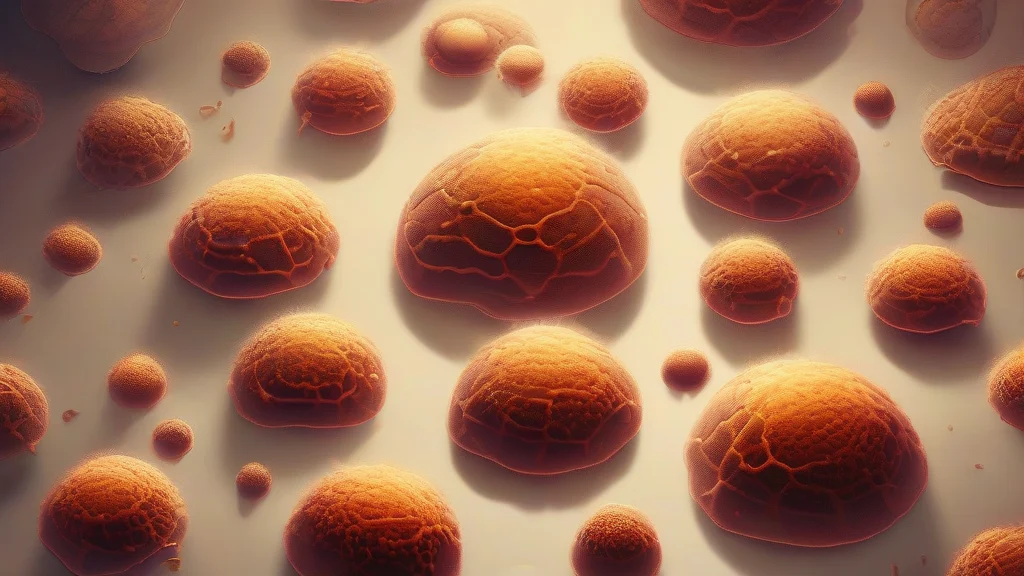
What does eukaryote mean?
A eukaryote is any organism whose cells contain a true nucleus — a membrane-bound compartment enclosing its DNA — along with other specialized structures called organelles, such as mitochondria. This architecture sets eukaryotes apart from prokaryotes (bacteria and archaea), whose cells lack a nucleus. The group encompasses an enormous range of life: all animals, plants, fungi, and protists are eukaryotes, whether they consist of a single cell or many trillions. Biologists consider the emergence of the eukaryotic cell one of the pivotal events in the history of life, likely arising through a close partnership between ancient simple cells over two billion years ago. The word is technical in register, appearing mainly in scientific writing and textbooks, though it is familiar to students of biology at nearly every level. Its adjective form, 'eukaryotic', is frequently used to describe cells, organisms, or lineages possessing this defining nuclear structure.
nounAn organism whose cells contain a distinct membrane-bound nucleus and other membrane-bound organelles. Eukaryotes include animals, plants, fungi, and protists.
- An organism composed of one or more cells that contain a membrane-bound nucleus and organelles; members of the taxonomic grouping Eukarya.
"Unlike bacteria, a eukaryote keeps its genetic material enclosed within a nucleus."
"Humans are multicellular eukaryotes, with each cell housing its DNA inside a nucleus."
"Amoebas are single-celled eukaryotes, yet their cells are far more complex internally than those of any bacterium."
Regular plural formed by adding -s.
"All complex multicellular life on Earth consists of eukaryotes."
Every plant, animal, fungus, and seaweed you've ever seen is a eukaryote — but for most of life's history on Earth, the planet belonged entirely to cells without nuclei.
Reviewed by Deb Chak, Editor. AI-assisted content curated by RJS Tech Solutions LLP.
Etymology of eukaryote
The term 'eukaryote' derives from Greek roots: 'eu-' meaning 'true' or 'well', and 'karyon' meaning 'nut' or 'kernel', referring to the cell's nucleus. It was introduced into biological terminology in the early twentieth century as microscopy revealed the fundamental division between nucleated and non-nucleated cells. The same Greek root 'karyon' appears in related scientific terms such as 'karyotype', while the prefix 'eu-' recurs in words like 'euphoria'.
Related word forms
How eukaryote is actually used
A technical term used chiefly in biology and education; in general conversation, the adjective form 'eukaryotic' is often more common than the noun itself. The older spelling 'eucaryote' is now largely obsolete.
Easily confused with eukaryote
A prokaryote is an organism whose cells lack a membrane-bound nucleus and organelles, such as bacteria and archaea, whereas a eukaryote possesses them.