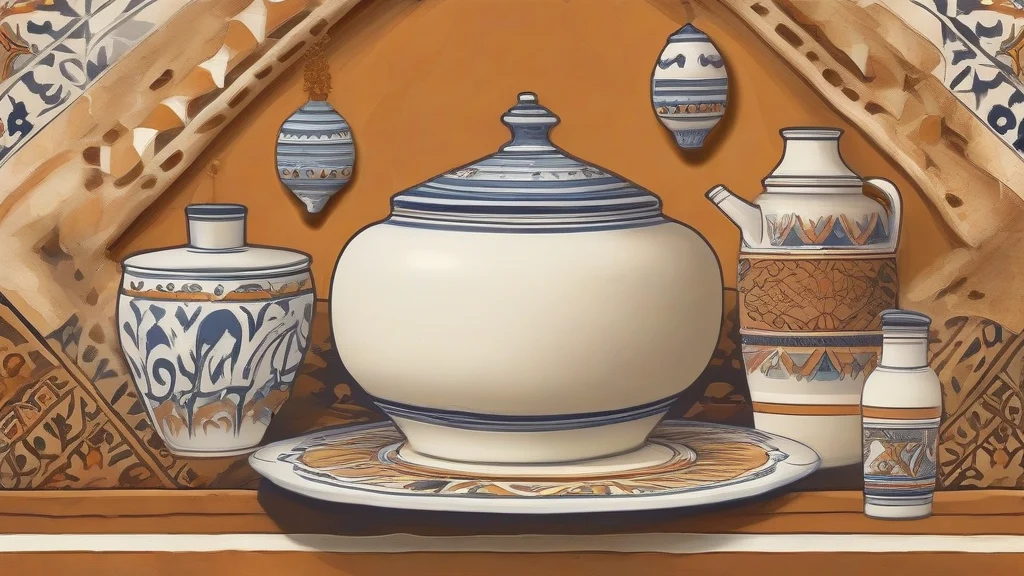
What does faience mean?
Faience is a type of glazed ceramic ware, most commonly understood as tin-glazed earthenware coated with an opaque white glaze and painted with decorative designs. The name derives from Faenza, the Italian city whose Renaissance workshops produced some of the finest examples of this craft. European potters adopted tin glazing because it created a brilliant white surface resembling Chinese porcelain, onto which colourful scenes could be painted before firing. The word also has a second, distinct archaeological sense: 'Egyptian faience' refers to ancient glazed objects made from crushed quartz rather than clay, prized for their luminous blue-green surfaces and used for beads, amulets, and small vessels as early as the fourth millennium BC. Because it names a specialised category of ceramics, faience appears mainly in museums, art history, and archaeology rather than casual conversation, where terms like 'pottery' or 'ceramics' would be more natural.
Fine tin-glazed earthenware with an opaque white glaze and painted decoration, especially that made in France and Italy.
"The chateau's kitchen is lined with eighteenth-century faience tiles depicting fruits and flowers."
Often preceded by a national or regional adjective, e.g. 'French faience' or 'Nevers faience'.
In archaeology, a glazed non-clay ceramic made primarily of crushed quartz, characteristic of ancient Egyptian and Near Eastern craftsmanship.
"The excavators recovered dozens of faience amulets from the burial chamber."
Usually qualified as 'Egyptian faience' to distinguish it from the European tin-glazed ware.
Faience is most often used as an uncountable mass noun referring to the material or class of ware. The plural 'faiences' occurs occasionally when referring to individual pieces or distinct varieties, though many writers prefer 'pieces of faience'.
"The auction catalogue listed several faiences from Nevers alongside Dutch delftware."
Faience takes its name not from a potter but from a city: Faenza in Italy, whose workshops were so famous that their wares lent their name to an entire class of ceramics.
Reviewed by Deb Chak, Editor. AI-assisted content curated by RJS Tech Solutions LLP.
Etymology of faience
The word faience entered English from French in the seventeenth century, borrowed ultimately from the Italian name of the city of Faenza in Emilia-Romagna. Faenza was renowned from the Renaissance onward for its production of tin-glazed earthenware, so much so that its name became the generic term for such ceramics across much of Europe. Cognates appear throughout European languages, including French faïence, German Fayence, and Italian maiolica traditions associated with the same technique.
How faience is actually used
Faience is used almost exclusively in art-historical, archaeological, and antiquarian contexts; it is rare in everyday speech. It functions as both a mass noun ('a piece of faience') and, less commonly, a count noun ('a faience'). In archaeology, 'Egyptian faience' is a technical term for quartz-based glazed material, which is compositionally quite different from European tin-glazed earthenware.
Easily confused with faience
Majolica is the Italian tradition of tin-glazed earthenware with vivid lead-glaze colours, while faience refers to the French and broader European tin-glazed tradition — though both describe similar pottery techniques.