
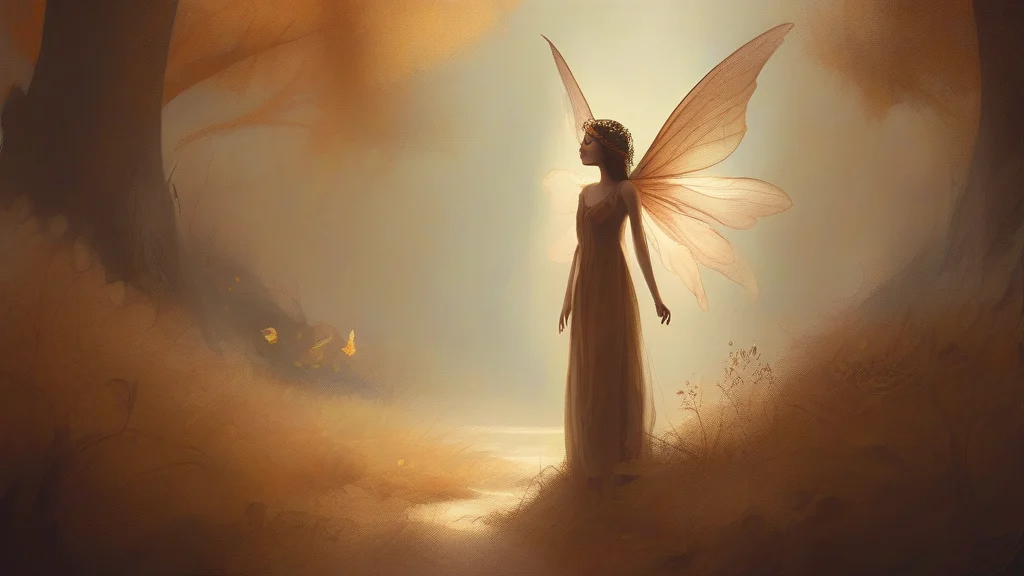
What does fairy mean?
A fairy is a legendary creature from European folklore, imagined as a small, humanlike being with magical powers, often portrayed as beautiful, delicate, and winged. Fairies appear throughout myth, legend, and literature, from medieval romances to modern children's stories such as those of Tinker Bell and the tooth fairy, where they are associated with enchantment, wishes, and mischief. In everyday English the word survives chiefly in fixed phrases like "fairy tale," "fairy godmother," and "fairy lights." The word can also be used figuratively to describe something delicate, dainty, or seemingly enchanted. Historically, belief in fairies was once widespread across Britain and Ireland, where they were regarded as powerful spirits to be treated cautiously rather than merely charming playmates. Today the word evokes wonder and imagination, though it should be used carefully when applied to people, since as slang it has been used as an offensive slur.
nounA small imaginary being of human form, typically depicted as delicate, winged, and endowed with magical powers in folklore and fairy tales.
- An imaginary magical being of folklore, usually small, humanlike, and often winged.
- (informal) A gay man — now widely considered offensive when used by outsiders.
"The children left a tiny note under the oak tree for the fairy they believed lived there."
"In the story, a fairy grants the woodcutter three wishes."
"She strung fairy lights along the balcony for the evening party."
Regular plural: the -y changes to -ies after the consonant sound.
"Folklore is full of fairies that reward kindness and punish greed."
The word "fairy" traces back to the Latin "fatum," meaning fate — so a fairy is literally a creature of destiny.
Reviewed by Deb Chak, Editor. AI-assisted content curated by RJS Tech Solutions LLP.
Etymology of fairy
The word fairy entered English in the Middle Ages via Old French "faierie," meaning both enchantment and the realm of the fays, derived from "faye," from Late Latin "fata," the Fates themselves, ultimately from Latin "fatum" (fate). It thus originally referred to enchantment or the land of the fays before settling on the beings themselves. Cognates include the archaic English "fay" and French "fée." The spelling "faerie" preserves the older literary tradition.
Related word forms
How fairy is actually used
As a noun for the mythical being, the word is neutral and common in children's literature and folklore. When applied to people, especially as a term for a gay man, it carries strong derogatory connotations and should be avoided. The compound "fairy tale" is so established that it is written as one word ("fairytale") when used adjectivally.
Easily confused with fairy
"Faerie" is an archaic or literary spelling of fairy, often chosen to evoke an older, more mystical tone, while "fairy" is the standard modern form.