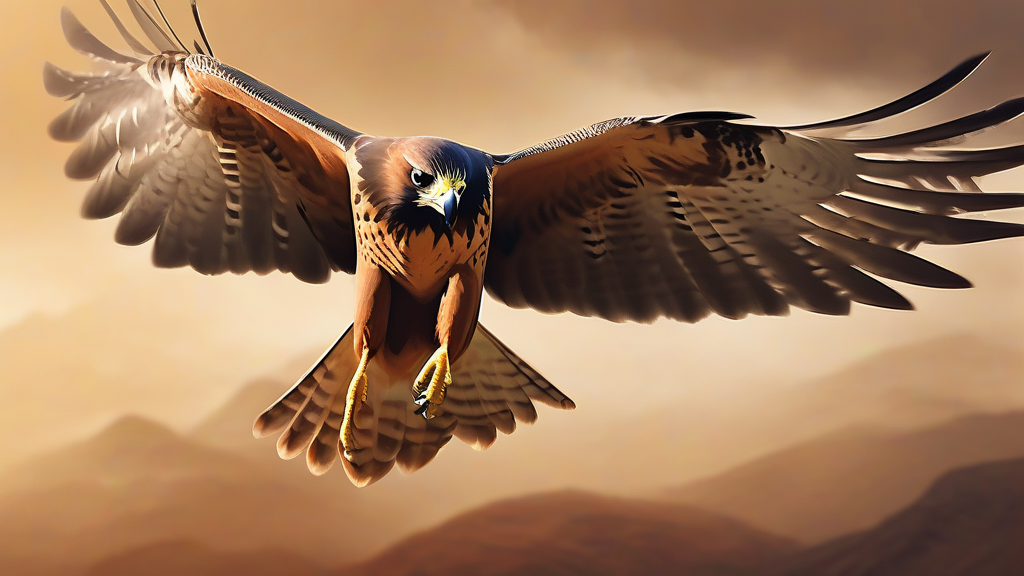
What does falcon mean?
A falcon is a bird of prey belonging to the genus Falco, a group that includes the peregrine falcon, the gyrfalcon, and the kestrel. Falcons are distinguished by their long, pointed wings, streamlined bodies, sharply hooked beaks, and extraordinary speed — the peregrine falcon's hunting dive is the fastest movement of any animal on Earth. Unlike hawks and eagles, which belong to a different family, true falcons typically kill their prey with a blow of the beak rather than the talons. The word also carries strong cultural resonance: for centuries falcons were trained for falconry, the aristocratic sport of hunting with birds, and they remain symbols of swiftness, precision, and nobility in heraldry, literature, and sport. Whether describing a wild hunter over open skies or a trained hunting companion, "falcon" evokes unmatched aerial mastery.
A diurnal bird of prey of the genus Falco, characterized by long pointed wings, rapid and agile flight, and a hooked beak with a distinctive notch; includes species such as the peregrine falcon and kestrel.
"Peregrine falcons have adapted remarkably well to city life, nesting on skyscraper ledges and feeding on pigeons."
In strict ornithological usage, only members of the family Falconidae are true falcons; in casual speech the term is occasionally extended to other swift birds of prey.
A female falcon, especially one trained for hunting in falconry, as distinguished from the male, which is called a tiercel.
"The falconer flew his falcon at dawn, when the quarry was least wary."
Regular plural; simply add -s.
"Falcons migrate south each autumn, following the corridors of migrating songbirds."
The peregrine falcon isn't just fast for a bird — its hunting dive tops 240 mph, making it the fastest animal on Earth.
Reviewed by Deb Chak, Editor. AI-assisted content curated by RJS Tech Solutions LLP.
Etymology of falcon
The word "falcon" entered Middle English in the 13th century by way of Old French "faucon," itself derived from Late Latin "falco." Many etymologists connect "falco" to Latin "falx," meaning "sickle," a plausible reference to the bird's curved talons or hooked beak, though this derivation is not universally accepted. Related forms survive across European languages, including French "faucon" and Italian "falco." The derivative "falconry," denoting the sport of hunting with trained falcons, reflects the word's deep association with medieval aristocratic culture.
Related word forms
How falcon is actually used
"Falcon" is a neutral, standard word used in both everyday and scientific contexts. In ornithology it refers specifically to members of the genus Falco and the family Falconidae, while colloquially it is sometimes applied loosely to other birds of prey — though specialists distinguish falcons from hawks and eagles by wing shape, beak structure, and hunting style.
Easily confused with falcon
Hawks are birds of the family Accipitridae, whereas true falcons belong to Falconidae and are distinguished by their long pointed wings, toothed upper beak, and habit of killing prey with a strike of the beak rather than the talons.