What does fancywork mean?
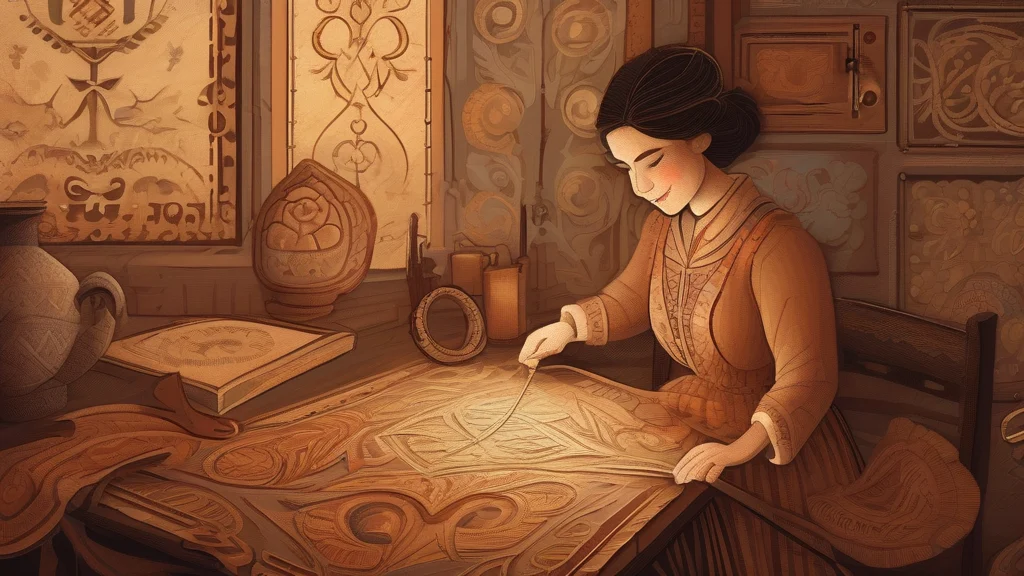
Fancywork is decorative needlework or ornamental handiwork — embroidery, crochet, knitting, tatting, and similar crafts pursued for beauty rather than pure utility. The term was once a household staple, especially in the nineteenth and early twentieth centuries, when sampler-making, doily-tatting, and embroidered linens were standard accomplishments in many homes. Today it survives largely in discussions of traditional crafts, heirlooms, and historical writing, giving it a gently old-fashioned, domestic connotation. A secondary, figurative use describes any elaborate or overly showy workmanship, often with a hint of dismissal — ornament prized over substance. For writers, fancywork is a useful word precisely because it names a whole family of decorative crafts in a single term, evoking patience, skill, and a bygone era of handmade adornment.
Decorative needlework or other ornamental handiwork, such as embroidery, crochet, tatting, or knitting, produced for adornment rather than necessity.
"The quilt's borders were embellished with fancywork stitched by three generations of the family."
Often used of heirloom or vintage textile crafts; the word has a distinctly traditional, domestic register.
Figuratively, elaborate or excessively ornate workmanship of any kind, sometimes implying style over substance.
"Critics complained that the building's facade was all fancywork with no structural elegance underneath."
This extended sense is less common and can carry a dismissive tone.
Rarely pluralized; the word is usually treated as uncountable, referring to the craft or category of ornamental work collectively. A plural may occasionally appear when counting distinct individual pieces.
"The display case held a dozen small fancyworks, each more intricate than the last."
Before television filled the evenings, women whiled away the dark hours doing "fancywork" — a word that literally turns the idea of mere imagination into stitches you can hold.
Reviewed by Deb Chak, Editor. AI-assisted content curated by RJS Tech Solutions LLP.
Etymology of fancywork
Fancywork combines "fancy," a contraction of "fantasy," with "work." "Fantasy" derives via Latin and Greek ultimately from the Greek "phantasia," meaning appearance or imagination, from "phainein," to show. The compound thus playfully applies a word rooted in imagination and appearance to tangible handwork, emerging in English usage around the eighteenth and nineteenth centuries as domestic decorative crafts flourished.
How fancywork is actually used
The word carries a mildly old-fashioned, domestic flavor and is most often heard in discussions of traditional handicrafts, heirloom textiles, or historical contexts. In its figurative sense it can be faintly dismissive, implying ornamentation at the expense of substance.
Easily confused with fancywork
"Fancy" refers to imagination or a liking for something, while "fancywork" refers specifically to decorative handmade work such as embroidery or ornamental stitching.