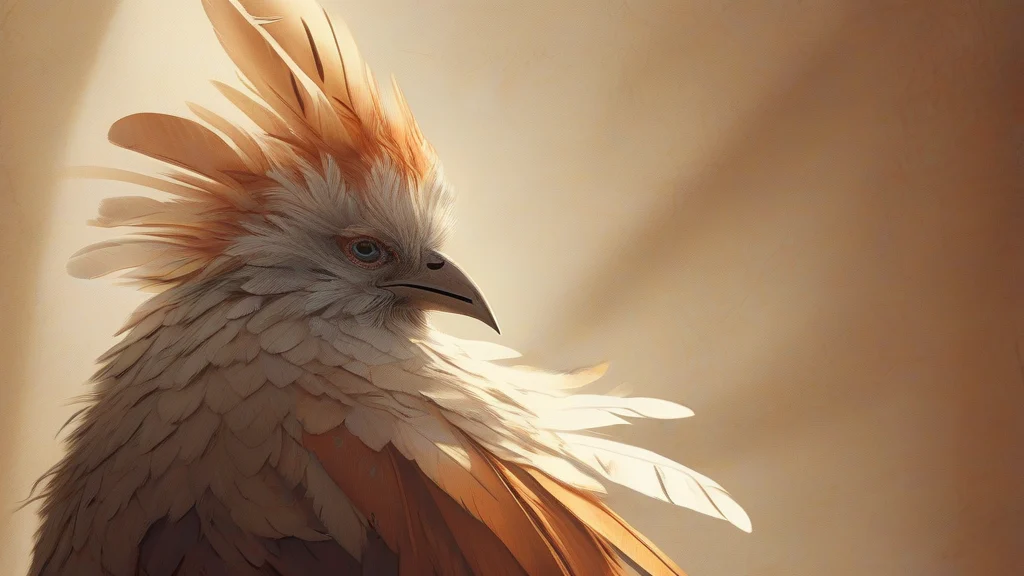
What does feathered mean?
Feathered is an adjective describing something covered with feathers or made to resemble them. Its most literal use applies to birds themselves — 'the feathered hunter watched silently from the branch' — while its extended uses cover anything dressed or trimmed with feathers, such as a feathered headdress, boa, or arrow fletching, and even soft, layered hairstyles described as feathered. The word carries warm, often affectionate connotations: English speakers routinely call birds 'our feathered friends,' a phrase so entrenched it functions almost as a synonym for birds as a group. In paleontology, 'feathered dinosaurs' has become a standard term reflecting the discovery that many theropods bore feathers long before flight evolved. Derived from the ancient noun 'feather,' which traces back through Old English to a Proto-Indo-European root meaning 'to fly,' feathered connects everyday description to one of nature's most remarkable evolutionary stories, making it both practical and evocative in modern usage.
Covered with feathers, or made of, decorated with, or resembling feathers.
"The museum's exhibit featured a remarkably preserved feathered dinosaur fossil."
Commonly used attributively; the plural sense of the underlying noun does not affect the adjectival form.
Simple past tense and past participle of 'feather': to furnish or cover with feathers, or to grow feathers.
"The arrows were feathered carefully to ensure a true flight."
Birds aren't the only creatures that wore this word — scientists now say many dinosaurs strutted around fully feathered millions of years before flight.
Reviewed by Deb Chak, Editor. AI-assisted content curated by RJS Tech Solutions LLP.
Etymology of feathered
The word feathered derives from 'feather,' which comes from Old English 'fēðer,' meaning the plumage of a bird. This noun descends from Proto-Germanic roots and ultimately from the Proto-Indo-European root '*pet-,' meaning 'to fly' or 'to rush.' The same ancient root gave rise to Greek 'pteron' (wing), which appears in scientific terms such as 'pterodactyl' and 'helicopter,' making feathered a distant cousin of those flying words. The participial adjective form developed naturally in Middle and Early Modern English as a straightforward way to describe things covered or adorned with feathers.
Related word forms
How feathered is actually used
Most often used attributively before a noun ('feathered friend', 'feathered tribe'), though it can follow a linking verb ('the bird was feathered'). The phrase 'our feathered friends' is a familiar, slightly affectionate way of referring to birds in general. In hairstyling, 'feathered' refers to a layered cut popular since the 1970s.
Easily confused with feathered
Feathered means actually covered with or made of feathers, while feathery describes something merely light, soft, or delicate like a feather.
Fathered means to have become the father of something, whereas feathered relates to feathers; the two differ by only one letter and one sound.