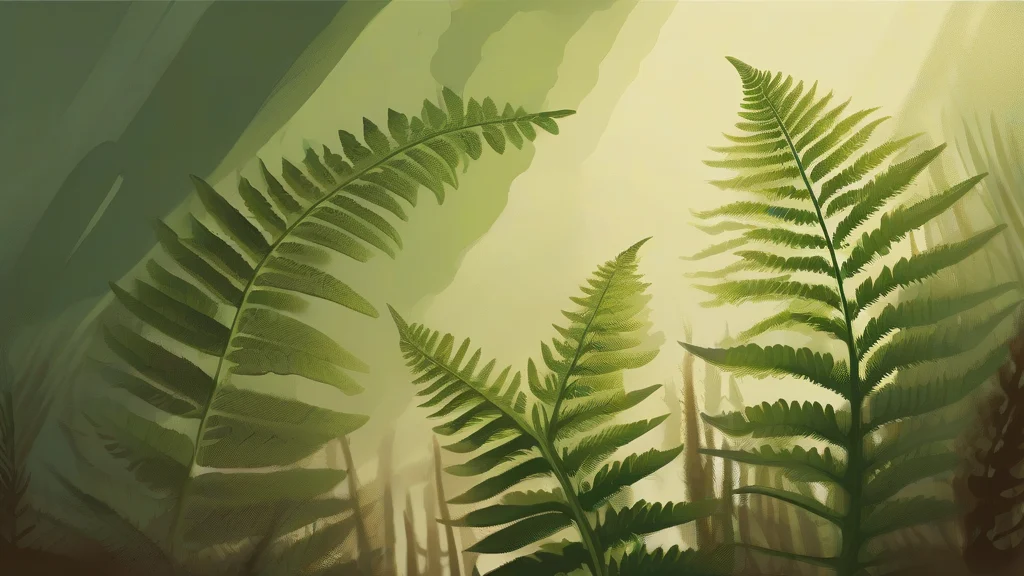
What does fern mean?
A fern is any of a large group of flowerless, seedless plants belonging to the division Pteridophyta, distinguished by their graceful, feathery leaves — called fronds — and their reproduction by microscopic spores rather than seeds. Ferns flourish worldwide in moist, shaded environments such as woodland floors, ravines, and stream banks, though many species are also prized as houseplants, including the popular Boston and maidenhair ferns. Ancient beyond measure, ferns predate the dinosaurs, having thrived for hundreds of millions of years, which gives them an aura of quiet timelessness in gardens and literature alike. The word commonly denotes both individual plants and the group as a whole, and it appears frequently in descriptions of natural scenery. Related terms such as "ferny" and "fernery" extend its reach into everyday description and gardening vocabulary, making "fern" a small but richly rooted part of the English lexicon.
nounA flowerless plant of the division Pteridophyta, with feathery green fronds and spores rather than seeds for reproduction, typically growing in damp, shaded habitats.
- Any of numerous flowerless plants of the division Pteridophyta having feathery fronds that reproduce via spores.
"The shaded ravine was carpeted with ferns that unfurled each spring."
"A maidenhair fern thrived in the steamy bathroom window."
"Victorian gardeners were so obsessed with ferns that the craze earned its own name: pteridomania."
Regular countable plural; used when referring to multiple plants or species collectively.
"The greenhouse held dozens of ferns from every continent."
Ferns are older than dinosaurs — they've reproduced by spores, not seeds, for over 350 million years.
Reviewed by Deb Chak, Editor. AI-assisted content curated by RJS Tech Solutions LLP.
Etymology of fern
"Fern" descends from Old English "fearn," tracing back through Proto-Germanic to ancient roots shared with other early Germanic languages; modern German retains the cognate "Farn." The word is among the oldest plant names in English, attested since the earliest written records of the language, reflecting how familiar these plants were to Anglo-Saxon speakers. Its derivatives such as "ferny" and "fernery" developed much later, in the early modern and Victorian periods.
Related word forms
How fern is actually used
Always a countable noun in botanical use; figurative uses are rare. In casual speech, "fern" often refers broadly to any houseplant with feathery fronds, even ones botanists would not classify as true ferns.
Easily confused with fern
"Fern" is the plant; "furn" is simply a common misspelling and not an independent English word.