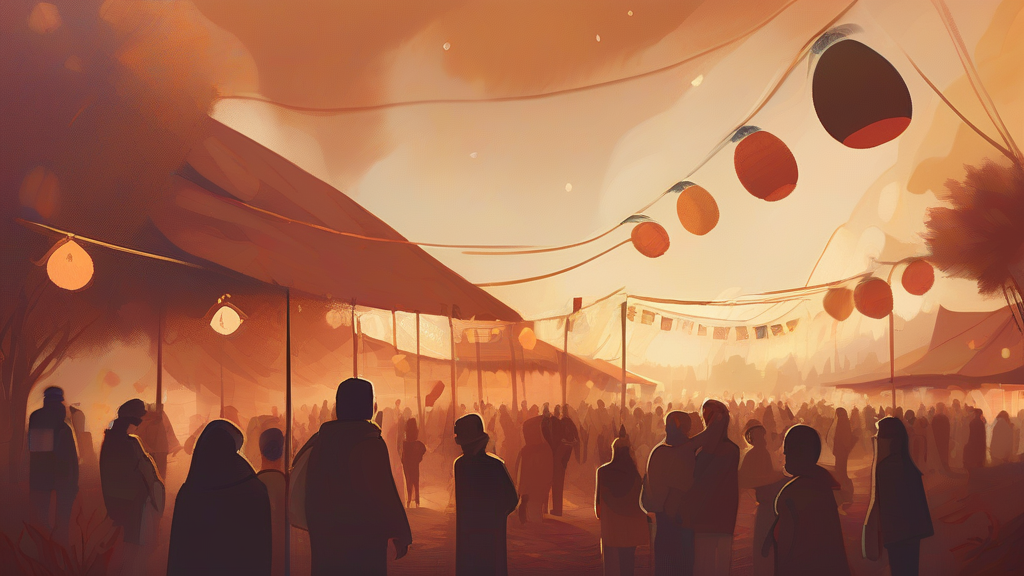
What does festival mean?
A festival is a day or period devoted to celebration, whether rooted in religion, culture, or the arts. The word covers both solemn observances — such as Easter or Diwali — and large public gatherings built around music, film, food, or literature. Festivals are typically recurring events, often tied to a season, calendar date, or community tradition, and they carry strong connotations of joy, togetherness, and shared identity. In contemporary English, the term is especially associated with organized arts events: a music festival may span several days and draw tens of thousands of attendees, while a film festival showcases new work and awards prizes. Derived from Latin festum, meaning feast or holiday, festival has long served as the natural word for occasions when ordinary life pauses and communities gather to celebrate what they hold in common. It remains one of the most versatile and widely used words for human celebration across cultures.
nounA day or period of celebration, typically marked by public festivities, religious observance, or cultural events such as music and film.
- An organized series of events or performances, especially of music, film, or drama.
- A day or period of religious or cultural celebration.
"The town's harvest festival draws visitors from across the region every autumn."
"She spent the weekend volunteering at a folk festival on the coast."
"Lunar New Year is the most important traditional festival in many East Asian cultures."
Standard regular plural; used when referring to multiple events or multiple occurrences of the same annual celebration.
"The city hosts several international festivals throughout the year."
The ancient Romans had over a hundred festival days a year — some estimates suggest citizens spent more time celebrating than working.
Reviewed by Deb Chak, Editor. AI-assisted content curated by RJS Tech Solutions LLP.
Etymology of festival
Festival derives from the Latin festum, meaning 'feast' or 'holiday', via the adjective festus ('joyous, festive'). It entered English through Old French in the late medieval period, with adjective use appearing first and the noun sense of a celebratory event developing later. It shares its Latin root with related English words including festive, festivity, and festoon, all pointing back to the same idea of joyful celebration.
Related word forms
How festival is actually used
Festival is neutral in register and appears in both formal and informal contexts. In modern usage it frequently refers to recurring arts events (e.g. a jazz festival), while in religious and cultural contexts it denotes annual holy days or celebrations. It is countable and takes regular plural inflection.
Easily confused with festival
Festive is an adjective describing a cheerful, celebratory atmosphere, while festival is a noun denoting the celebration or event itself.