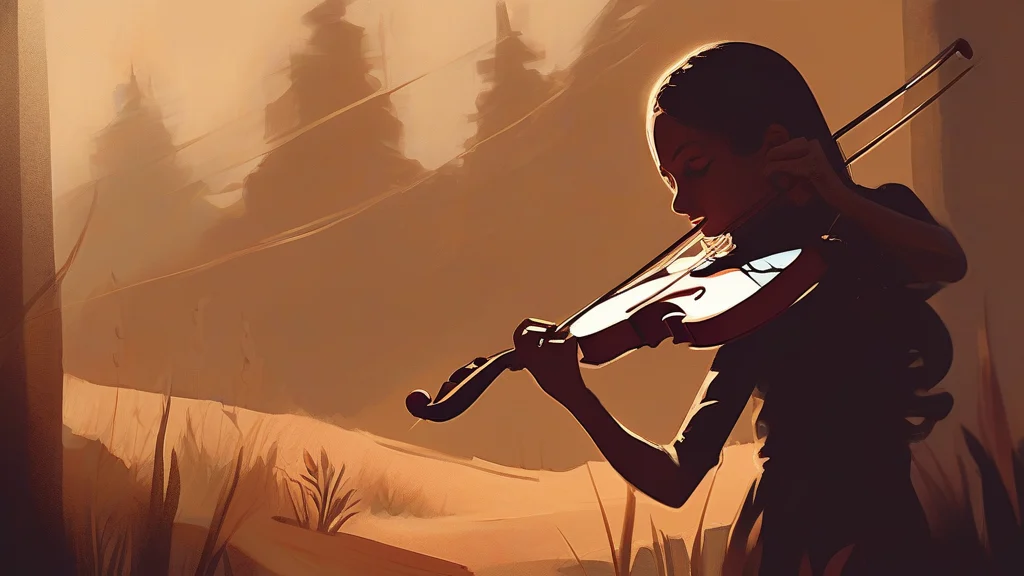
What does fiddlestick mean?
Fiddlestick literally means the bow used to play a violin — a fiddle being a colloquial name for that instrument. In contemporary English, however, the word survives almost entirely through its exclamatory form, 'fiddlesticks!', a mild, good-humored way to express annoyance, frustration, or disbelief, roughly equivalent to 'nonsense!' or 'oh, bother!'. The expression dates from around the early seventeenth century and has always carried a quaint, slightly old-fashioned flavor; today it sounds deliberately genteel or comic rather than current. It appears most often in British English and in fiction that wants a character's irritation to sound harmless and charming. A related idiom, 'I don't care a fiddlestick,' dismisses something as unimportant. Because the word evokes both music-making and polite exasperation, it remains a favorite of writers seeking period color or gentle humor, even though few speakers now recall its original musical meaning.
nounA fiddlestick is literally the bow used to play a violin or fiddle, but in modern usage the word survives almost exclusively as the basis of the exclamation 'fiddlesticks!', a mild expression of annoyance, disbelief, or dismissal regarded as old-fashioned.
- As an interjection-derived noun: 'fiddlesticks!' expresses mild annoyance, disbelief, or dismissal of something as nonsense (the dominant modern use).
- The literal sense: the bow with which a violin or fiddle is played (historical, now rare).
- In the phrase 'first fiddle', the leading instrument in a group — hence 'to play first fiddle' (archaic).
""Oh, fiddlesticks!" she cried, realizing she'd left the tickets at home."
""Fiddlesticks! I've missed the last bus.""
"He dismissed the rumor as mere fiddlesticks."
The plural 'fiddlesticks' is overwhelmingly more common than the singular, functioning chiefly as the interjectional exclamation of annoyance or disbelief.
""Oh, fiddlesticks! I've forgotten my keys again.""
The word for a violinist's bow became one of history's politest ways to say "that's nonsense" — and it's been charming grannies and novelists ever since.
Reviewed by Deb Chak, Editor. AI-assisted content curated by RJS Tech Solutions LLP.
Etymology of fiddlestick
Fiddlestick combines 'fiddle', a word of Germanic origin (ultimately from medieval Latin 'vitula' or related Romanic sources) denoting a stringed instrument, with 'stick', referring to the bow. The literal sense — the violinist's bow — is attested from around the fifteenth to sixteenth century. The figurative exclamation 'fiddlesticks!' arose in English by the early seventeenth century, possibly influenced by the idea of the bow as something trivial or by the nonsense associated with poor fiddle-playing. Related words include the simple 'fiddle' itself, 'fiddler', and the musical idiom 'to play second fiddle'.
Related word forms
How fiddlestick is actually used
Register: distinctly informal and old-fashioned; carries a gentle, quaint, almost Victorian connotation — it expresses irritation without any real offense. More common in British English than American. The plural form 'fiddlesticks' is far more common than the singular 'fiddlestick'; the bare singular appears mostly in older idioms like 'I don't care a fiddlestick'.
Easily confused with fiddlestick
'Fiddly' describes something awkward or finicky to handle, whereas 'fiddlestick' refers either to a violin bow or, via 'fiddlesticks!', to mild exasperation or nonsense.