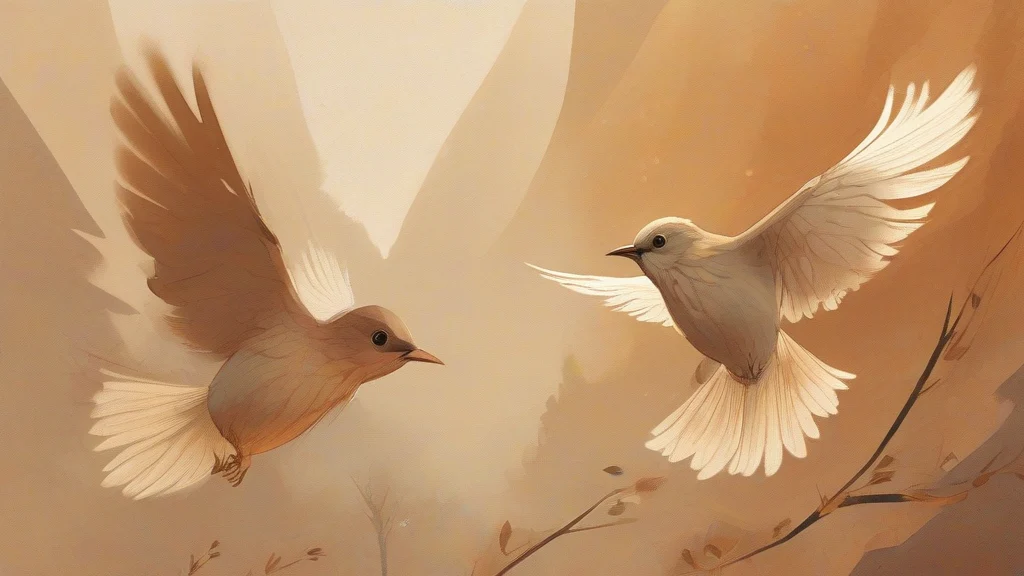
What does fledgeling mean?
A fledgeling is a young bird that has recently developed its flight feathers and is venturing out of the nest, often still clumsy in the air and dependent on its parents. The word also has a well-established figurative sense: any beginner or newcomer to a field, whether a fledgeling politician, a fledgeling company, or a fledgeling democracy. In this extended use it suggests youth, inexperience, and potential all at once, which gives it a warmer tone than blunter terms like 'amateur'. The word derives from 'fledge', meaning to acquire feathers capable of flight, combined with the suffix '-ling', denoting one characterized by something. It appears most often today as a modifier in phrases such as 'fledgeling industry' or 'fledgeling writer'. Note that 'fledgling', spelled without the middle 'e', is now the dominant form worldwide, though 'fledgeling' remains acceptable as a British variant.
nounA young bird that has recently acquired its flight feathers and is beginning to fly. More broadly, an inexperienced newcomer to a field, organization, or activity.
- A young bird that has recently grown its flight feathers and left the nest, or is just learning to fly.
- An inexperienced person who is new to a particular activity, profession, or sphere of life.
"The fledgeling robins hopped along the fence while their mother watched anxiously from the birch tree."
"Conservationists banded the fledgelings before they dispersed from the cliff-side colony."
"The fledgeling newspaper struggled through its first year on shoestring financing."
Standard plural, formed by adding -s. Used when referring to multiple young birds or multiple newcomers.
"The roof was crowded with squawking fledgelings awaiting their next meal."
The '-ling' ending that turns 'fledge' into 'fledgeling' is the same suffix that gives us 'sibling', 'duckling', and 'wretch' — it literally means 'one who is characterized by having just fledged.'
Reviewed by Deb Chak, Editor. AI-assisted content curated by RJS Tech Solutions LLP.
Etymology of fledgeling
The word comes from 'fledge', meaning to furnish with feathers or to become feathered enough for flight, which traces back through Middle English to Old English 'flycge', an adjective meaning able to fly, itself rooted in Germanic forms connected to flying birds. The suffix '-ling', common in English words like 'duckling' and 'sibling', was added to create a noun meaning 'one that has just fledged'. The word emerged in written use during the late medieval period, with 'fledgeling' arising as a variant spelling that inserts a connecting 'e' between the root and suffix. Its figurative sense for inexperienced newcomers developed later and became firmly established by the nineteenth century.
Related word forms
How fledgeling is actually used
'Fledgeling' is a variant spelling of 'fledgling'; both are pronounced identically. The double spelling reflects historical variation, but 'fledgling' dominates modern usage, especially in North America. The figurative sense carries a mildly sympathetic connotation, suggesting promise and inexperience rather than incompetence. When used attributively before another noun ('fledgeling industry'), it functions adjectivally without changing form.
Easily confused with fledgeling
Both spellings refer to exactly the same word; 'fledgling' is now the standard form in American English and increasingly everywhere else, while 'fledgeling' survives chiefly as a British variant.