
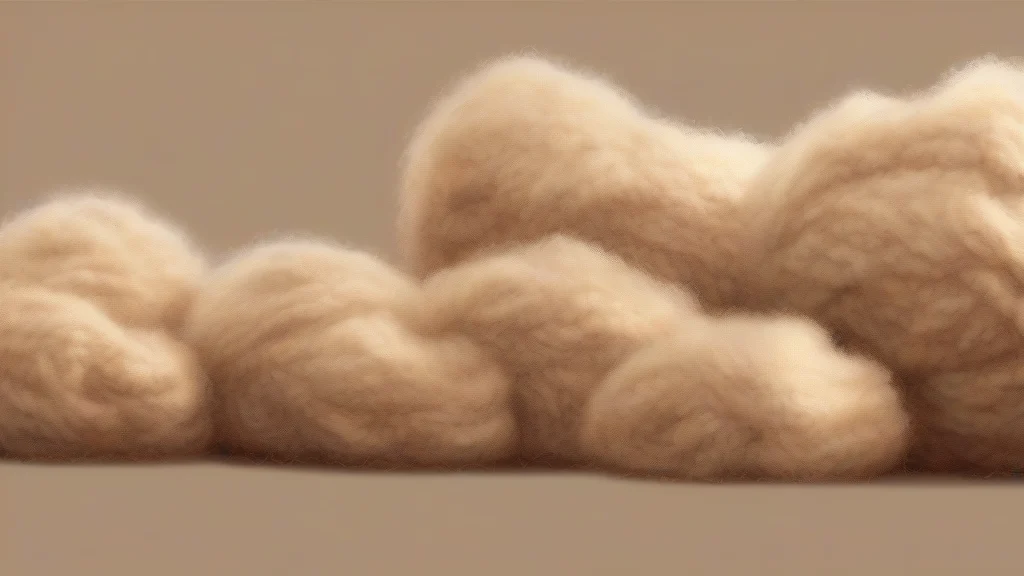
What does fleecier mean?
'Fleecier' is the comparative form of 'fleecy', an adjective describing the soft, fluffy, wool-like texture associated with fleece — whether the natural coat of a sheep, the plush nap of a blanket, or the downy covering of a young animal. Saying something is 'fleecier' therefore means it possesses more of that gentle, insulating softness than something else: a fleecier robe, a fleecier sweater, a fleecier winter coat. The word derives from 'fleece', the woolly covering shorn from sheep, a term that has been part of English since the Middle Ages and famously evokes the golden fleece of Greek myth. Warmly connotative and informal in register, 'fleecier' appears naturally in comparisons about comfort and coziness. It should not be confused with 'fleeced', which uses the same root but means cheated or swindled — a reminder that one English word can wrap both comfort and cunning.
adjective (comparative form of 'fleecy')More fleecy; covered with or resembling soft, woolly fleece to a greater degree. Used to compare two things in terms of their soft, fluffy, wool-like texture.
- Comparative degree of 'fleecy': having more of the soft, fluffy, wool-like quality of fleece.
"The lamb's winter coat was noticeably fleecier than it had been in spring."
"Her new bathrobe was even fleecier than the old one she'd finally worn out."
"The angora kitten's fur grew fleecier with each passing week."
The same root that gives us cozy blankets also gives us the con — 'fleecy' feels soft while its cousin 'fleeced' means you've been robbed.
Reviewed by Deb Chak, Editor. AI-assisted content curated by RJS Tech Solutions LLP.
Etymology of fleecier
'Fleecier' is formed by adding the standard comparative suffix '-ier' to 'fleecy', which itself derives from 'fleece' — the woolly coat of a sheep, a word present in English since medieval times through Old French 'flis'/'fleus' and ultimately Germanic roots. The noun 'fleece' has ancient resonance, appearing in the myth of Jason and the Golden Fleece. The adjective 'fleecy' extended the term beyond sheep's wool to anything resembling its soft, curly texture, and 'fleecier' simply expresses that quality in comparative degree.
Related word forms
How fleecier is actually used
'Fleecier' is exclusively the comparative form of the adjective 'fleecy' and appears only in comparative constructions or contexts ('fleecier than', 'even fleecier'). It carries a warm, cozy, positive connotation. Like most comparatives of everyday adjectives, it is used informally rather than in technical textile terminology.
Easily confused with fleecier
'Fleecier' describes a soft, woolly texture, while 'fleeced' means having been swindled or stripped of money — entirely different senses of the same root word.