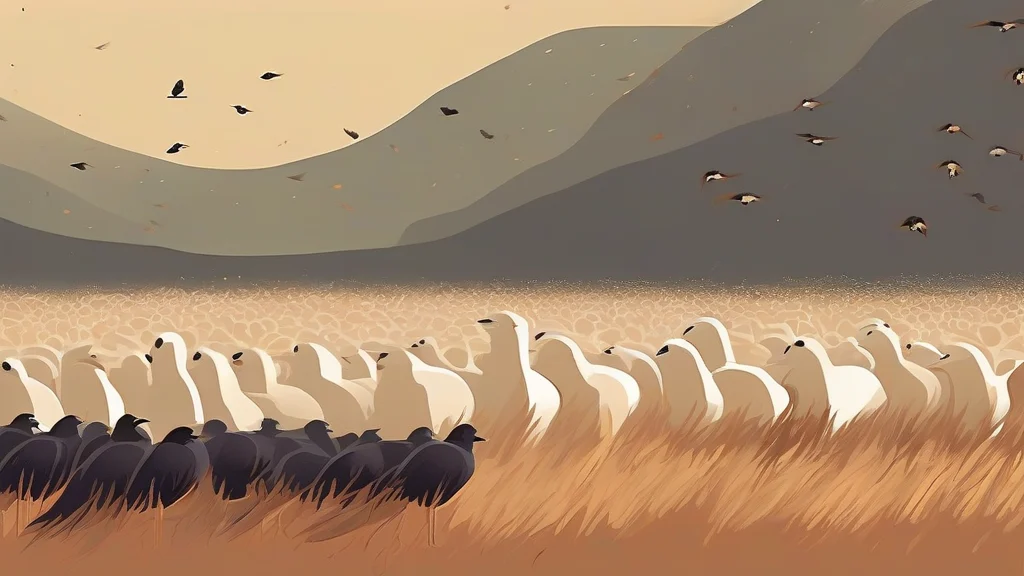
What does flocking mean?
Flocking most commonly denotes the act of gathering or moving together in a crowd or group, whether of birds wheeling as one in the sky, animals herding across a landscape, or people streaming towards an event or attraction. Derived from 'flock', a word long used for groups of birds and, by extension, crowds of people, the term captures both a natural phenomenon and a human social impulse; scientists even study 'flocking behaviour' as a model for coordinated motion in animals and algorithms alike. A second, quite distinct sense belongs to the world of textiles: flocking is also the fine fluffy fibre applied to surfaces to produce a soft, velvety texture, found on wallpaper, greeting cards, upholstery, and festive decorations. Context usually makes clear which sense applies — movement and crowds in everyday and scientific usage, surface texture in craft and manufacturing. Its dual life makes flocking a word that links the spectacle of a starling murmuration with the feel of a flocked velvet cushion.
The action of gathering or moving together in a flock or crowd; collectively, the behaviour of birds, animals, or people congregating en masse.
"The flocking of geese across the evening sky signalled the change of season."
A fine fluffy material of torn or minced fibres used for stuffing or for applying decoratively to surfaces, or the process of applying it to create a velvety texture.
"The wallpaper's deep green flocking gave the hallway an opulent, tactile quality."
This sense is largely confined to textile, craft, printing, and interior-design contexts.
Rarely used in the plural; when referring to multiple instances of decorative flocking or separate gatherings, pluralisation is possible but uncommon, with the singular typically preferred.
"Different flockings were applied to each panel of the display."
Flocking describes both the mesmerising murmurations of thousands of starlings and the fuzzy velvet-like coating on your Christmas jumper — one word, two very different worlds.
Reviewed by Deb Chak, Editor. AI-assisted content curated by RJS Tech Solutions LLP.
Etymology of flocking
Flocking derives from 'flock', an Old English word ('flocc') meaning a company of persons or a group of animals, which has cognates in other Germanic languages such as Old Norse 'flokkr'. The verb 'to flock', meaning to gather or move in a group, developed from this noun in the medieval period, and 'flocking' emerged as its gerund and action noun. The textile sense traces back through Middle English 'flok' meaning a lock of wool or tufted fibre, likely influenced by Old French 'floc' and ultimately related to Latin 'floccus', a tuft of wool — making the two senses etymologically intertwined though historically distinct strands of the same word.
Related word forms
How flocking is actually used
When describing people or animals moving together, 'flocking' often appears with the preposition 'to' (e.g. 'flocking to the beaches'). In its textile/decorative sense it is more common in manufacturing, craft, and design contexts. The group-behaviour sense carries broadly positive connotations of enthusiasm or shared interest.
Easily confused with flocking
Block refers to a solid piece of material or an obstruction, whereas flocking refers to grouping behaviour or fibre decoration; they share a similar sound but entirely different meanings.