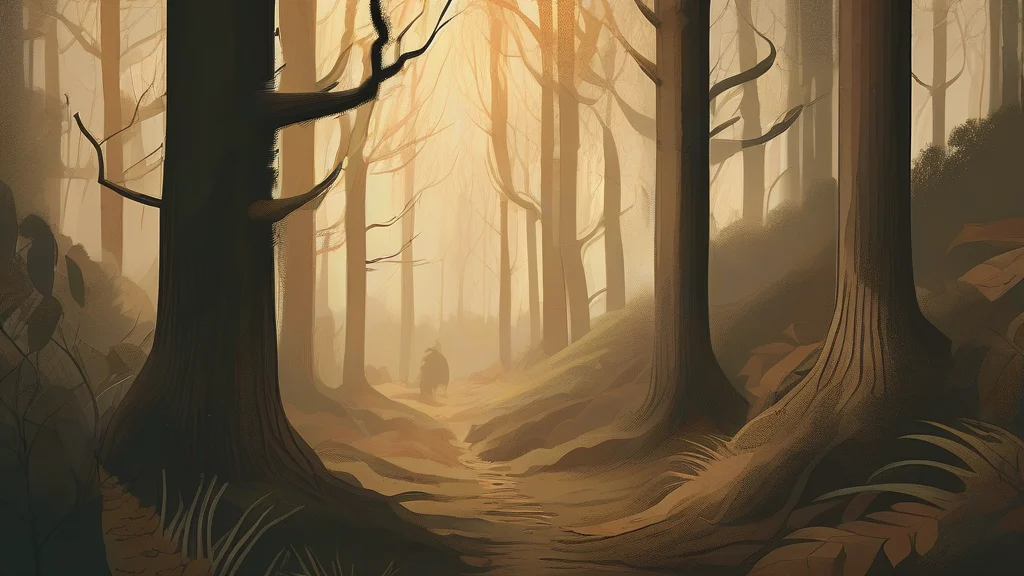
What does forest mean?
A forest is a large area of land dominated by trees and their associated undergrowth, forming one of Earth's principal terrestrial ecosystems. Forests range from dense tropical rainforests teeming with biodiversity to sparse boreal conifer forests encircling the Arctic, and they play a vital role in regulating climate, storing carbon, sheltering wildlife, and supplying timber. In ordinary usage the word suggests an extensive, often wild woodland — English speakers typically reserve it for larger tracts, using "woods" for smaller ones. Historically, the term had a different flavour in medieval England: a "forest" was land subject to royal forest law, reserved for hunting, and it need not have been wooded at all. The word appears in countless idioms, most famously "can't see the forest for the trees," meaning to miss the big picture by fixating on details. Its derivatives — forestry, forester, deforestation — reflect humanity's long economic and environmental relationship with wooded land.
A large area of land covered chiefly with trees and undergrowth.
"They hiked for hours through the ancient redwood forest."
Usually takes the indefinite article or a plural; "a forest" implies a substantial, self-contained woodland.
To cover or plant an area of land with trees.
"The government moved to forest the degraded hillsides."
Rare on its own; more common in derived forms such as "forested", "forestation", and "afforestation".
Standard countable plural; used both for multiple distinct woodlands and collectively (e.g. "the world's forests").
"Tropical forests are being cleared at an alarming rate."
Medieval English "forests" didn't have to contain any trees at all — they were legal zones where the king reserved the right to hunt.
Reviewed by Deb Chak, Editor. AI-assisted content curated by RJS Tech Solutions LLP.
Etymology of forest
The word "forest" entered Middle English from Old French "forest" (modern French "forêt"), which itself derives from medieval Latin "forestis (silva)", meaning open woodland or land outside enclosure. Despite its modern association with trees, the original sense was juridical rather than botanical — land outside the ordinary law, reserved for game. Cognates appear across the Romance languages, including Italian "foresta" and Spanish "floresta", all tracing back to the same Frankish-influenced Latin source.
Related word forms
How forest is actually used
In everyday British speech, "woods" or "the woods" is often used for smaller tracts of trees, while "forest" tends to suggest a vast expanse. The word carries broadly positive connotations of wilderness and nature, though it can appear in environmental writing to signal loss or threat (e.g. deforestation).
Easily confused with forest
"Forrest" is not a variant spelling of the word but a personal name (e.g. Forrest Gump); only "forest" refers to tree-covered land.