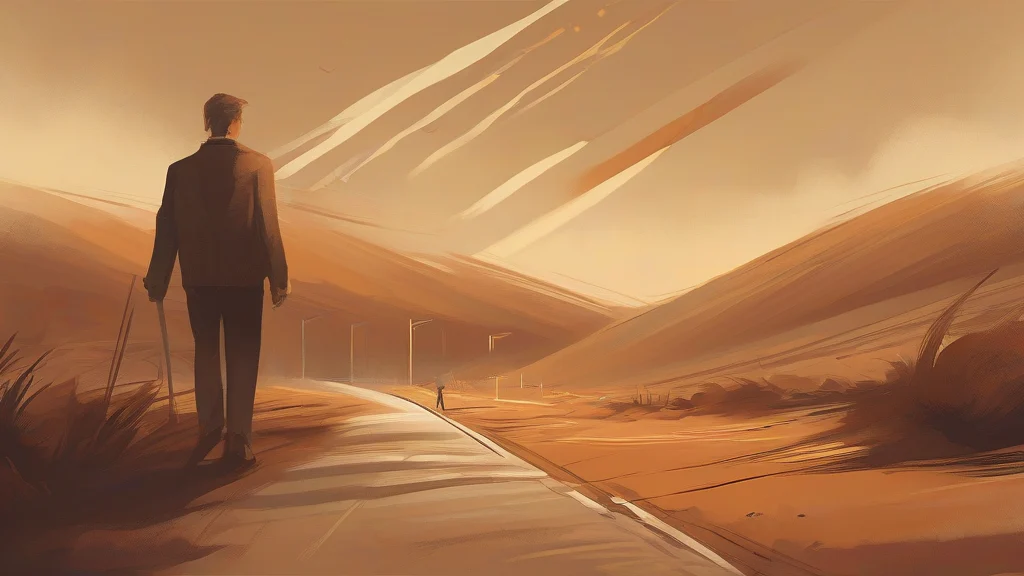
What does forward mean?
The word 'forward' describes movement or direction toward what lies ahead — whether through physical space, through time, or through a process of progress. It functions as an adverb ('step forward'), an adjective ('a forward position'), and a verb meaning to send something along to its next recipient, a role familiar to anyone who has ever forwarded an email. Its connotations are overwhelmingly positive: forward thinking suggests vision and initiative, while phrases like 'look forward to' express anticipation and hope. Derived from Old English elements 'fore' (ahead) and '-ward' (in a direction), it has been part of English for more than a millennium. British usage sometimes favours the variant 'forwards', though 'forward' remains standard in both countries. Versatile and deeply embedded in everyday language, it is essential vocabulary for describing ambition, planning, communication, and momentum.
In the direction that one is facing or travelling; onward in time or progress.
"The army marched forward at dawn."
Situated at or near the front; advanced or progressive in position, development, or attitude.
"She was notably forward in embracing the new technology."
When describing a person, 'forward' can imply boldness or lack of reserve, which may carry a mildly critical connotation.
To send a letter, message, or item on to a further destination or recipient.
"He forwarded the email to his manager for review."
A player positioned near the front of a team in sports such as football, basketball, or hockey, whose main role is to score or attack.
"The striker plays as a forward just behind the opposition's defence."
Used when referring to multiple attacking players on a team; the plural applies to the sports sense of the noun.
"The coach fielded three forwards in the second half."
'Forward' comes straight from Old English — it's built from 'fore' (ahead) plus '-ward' (in a direction), making it over a thousand years old yet still the word we reach for every time we hit 'send.'
Reviewed by Deb Chak, Editor. AI-assisted content curated by RJS Tech Solutions LLP.
Etymology of forward
Forward originates in Old English, formed by combining 'fore,' meaning ahead or earlier, with the suffix '-ward,' which indicates direction. This directional suffix family also produced words like 'backward' and 'toward,' all expressing orientation relative to a reference point. Related compounds from the same Old English root include 'foremost,' 'beforehand,' and 'forthcoming.' The word has remained remarkably stable in form and meaning across its long history in English.
Related word forms
How forward is actually used
As a verb, 'forward' commonly means to pass something (an email, letter) along to another recipient. In British English, the adverb form is often rendered 'forwards', while American English overwhelmingly prefers 'forward'. The phrase 'look forward to' carries a positive, anticipatory connotation.
Easily confused with forward
A foreword is an introductory section at the front of a book written by someone other than the author, whereas 'forward' refers to direction or sending things ahead.