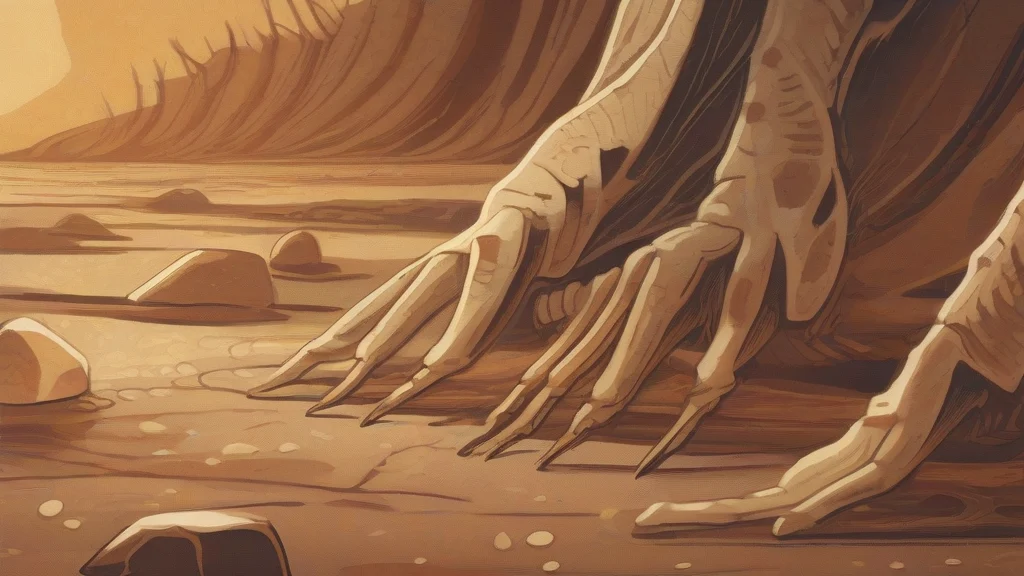
What does fossilizing mean?
Fossilizing describes two related kinds of transformation. In its literal sense, it names the slow geological process by which the remains of living things — bones, shells, wood, even footprints — are preserved as fossils. Over millions of years, minerals seeping through surrounding sediment gradually replace or fill in organic material, hardening it into stone while retaining its original structure. This sense belongs chiefly to palaeontology and geology, where it underpins how we read the history of life on Earth. The word also has an established figurative use: to say a person, institution, or industry is fossilizing is to suggest it is hardening around old habits and failing to adapt. That usage carries a mildly critical tone, implying stagnation rather than healthy stability. Whether applied to ancient bone or outdated thinking, fossilizing always conveys the same essential idea: something once alive and flexible becoming fixed, rigid, and unchanging.
To convert or be converted into a fossil through gradual mineral replacement; figuratively, to become fixed, rigid, or outdated in habits or outlook.
"Over millennia, groundwater rich in silica worked through the log, fossilizing every cell."
Typically used in progressive constructions because it denotes a continuing process.
The process or result of organic remains becoming a fossil.
"Fossilizing requires just the right conditions — rapid burial and mineral-rich water."
The gerund/noun sense overlaps with the more common term 'fossilization', which is preferred in technical writing.
Fossilizing is so slow that scientists have caught it mid-act — a 70-million-year-old T. rex bone still held soft tissue that hadn't yet finished turning to stone.
Reviewed by Deb Chak, Editor. AI-assisted content curated by RJS Tech Solutions LLP.
Etymology of fossilizing
Fossilizing derives from 'fossil', which comes from the Latin fossilis, meaning 'dug up' or 'obtained by digging' — originally applied to anything excavated from the ground, including minerals and gemstones, not just preserved remains. The English word fossil took on its modern, narrower meaning of preserved organic remains during the scientific developments of the seventeenth and eighteenth centuries. The verb form fossilize emerged as understanding of how these remains formed grew more precise, and cognates from the same Latin root include petrify and other terms for processes of mineral preservation.
Related word forms
How fossilizing is actually used
The literal sense is technical and appears mostly in geology, palaeontology, and popular science writing; the figurative sense — describing people or organisations as fossilizing — carries a mildly negative connotation of stagnation and resistance to change. The verb is usually used in progressive forms ('is fossilizing', 'was fossilizing') since it describes an ongoing process.
Easily confused with fossilizing
Petrifying refers specifically to organic matter being turned to stone (or colloquially to something terrifying), whereas fossilizing is the broader process of any remains becoming a fossil through mineral replacement.