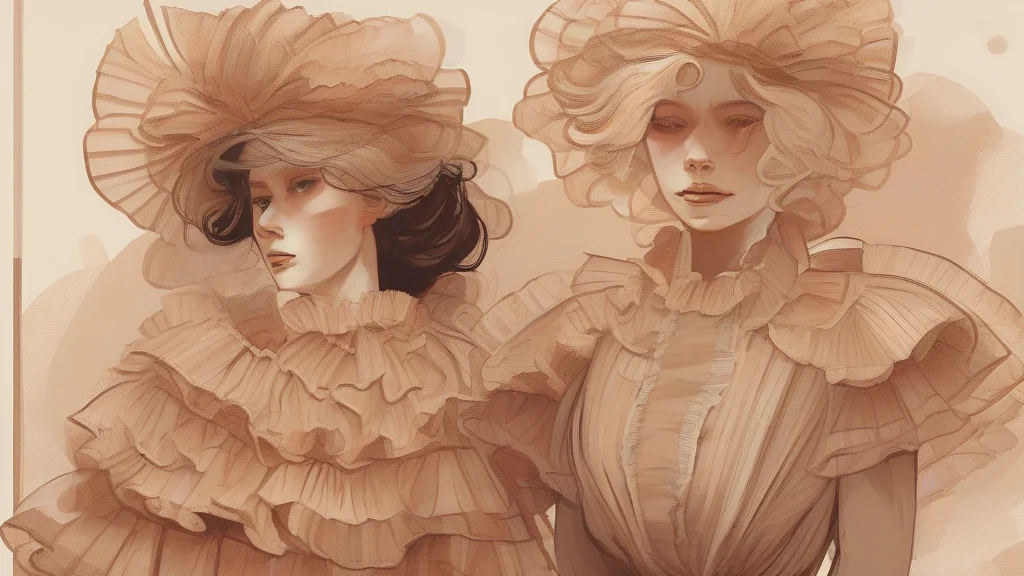
What does frilly mean?
Frilly is an adjective describing things adorned with frills — the gathered, ruffled strips of fabric used as decorative trim on clothing, curtains, cushions, and similar items. A frilly dress, for instance, is one layered with ruffles and lace rather than clean lines. By extension, the word is applied figuratively to any style perceived as overly ornate or fussy, from frilly handwriting to frilly prose, and in these uses it tends to carry a mild negative judgment: too much decoration, not enough substance. The word derives from 'frill', a noun dating to the sixteenth century that named such a ruffle of fabric, with the adjective forming later as a natural derivative. In register it is informal and domestic, belonging to conversations about fashion and home rather than technical discourse. It is useful precisely because it captures both a concrete visual quality and a broader aesthetic attitude in a single vivid word.
adjectiveDecorated with or characterized by frills — gathered, ruffled strips of fabric or ornamental trim; by extension, excessively elaborate, fussy, or ornate in style.
- (Of clothing, fabric, or decor) adorned with frills or ruffled trim.
- (Of style, writing, or design) excessively ornate, elaborate, or decorative in a way some consider fussy.
"The bride wore a frilly white gown trimmed with lace."
"She wore a frilly apron while baking on Sunday mornings."
"Critics dismissed the novel's prose as frilly, more ornament than substance."
Those little gathered strips of fabric called frills became so iconic that an entire adjective — 'frilly' — now sums up anything that's all decoration and fuss.
Reviewed by Deb Chak, Editor. AI-assisted content curated by RJS Tech Solutions LLP.
Etymology of frilly
Frilly is derived from 'frill', a term for a gathered or ruffled strip of fabric that appeared in English in the sixteenth century during the era of elaborate Elizabethan ruffs and cuffs. The ultimate origin of 'frill' itself is uncertain, though it has been linked to words describing crinkled or curled textures. The adjective 'frilly' formed straightforwardly from this noun, following the common English pattern of adding -y to create descriptive adjectives, and its figurative sense of 'excessively ornate' developed naturally from the physical meaning.
Related word forms
How frilly is actually used
Informal to neutral in register, 'frilly' is most often applied to clothing, linens, and household décor, where it can be affectionate or dismissive depending on tone. When transferred to abstract contexts such as prose or design, it usually carries a mildly pejorative connotation of needless ornamentation.
Easily confused with frilly
Frivolous describes something lacking serious purpose or value, while frilly describes physical ornamentation with ruffles or trim.
Frizzly refers to hair curled or kinked into tight tufts, whereas frilly refers to ruffled fabric trim.