What does galapago mean?
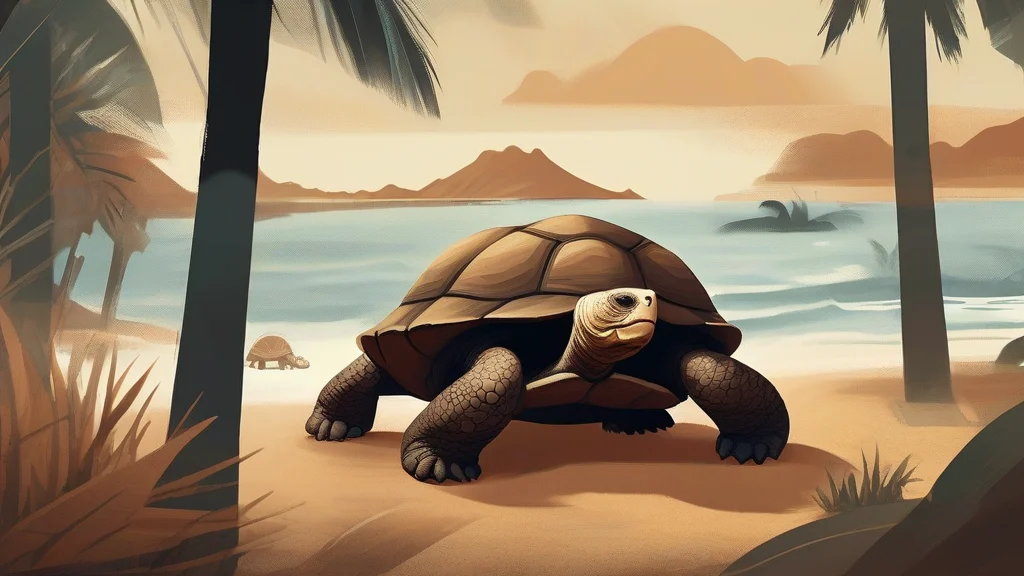
A galapago is a giant tortoise, above all one of the enormous land tortoises that inhabit the Galápagos Islands of Ecuador. The English word is a direct borrowing from Spanish, where 'galápago' names these reptiles — so central were they to European encounters with the archipelago that Spanish sailors took the animals' name and gave it to the islands themselves, coining 'the Galápagos Islands'. Because individual tortoises can live well over a century, the word has come to evoke extreme longevity, patience, and an almost geological slowness. Today 'galapago' remains a rare term in general English conversation, appearing mostly in zoology, conservation, and travel literature; most speakers reach instead for 'giant tortoise' or simply 'tortoise'. Its interest lies less in common usage than in its story: few place names in the world trace back, quite so literally, to the animals that inspired them.
nounA giant tortoise, especially one of the large land tortoises native to the Galápagos Islands; the word derives from the Spanish 'galápago', the name Spanish sailors gave these reptiles.
- A giant tortoise, particularly one of the long-lived land tortoises of the Galápagos Islands.
"The naturalists watched a ancient galapago graze slowly on the cactus pads of the volcanic highland."
"Centuries-old galapagos still lumber across the lava fields of Isabela Island."
"Darwin's notes describe how the crew harvested galapago after galapago for fresh meat during their stop at the archipelago."
Note that 'galapagos' as a plural of the animal should not be confused with 'the Galápagos', which names the island group.
"Conservationists have released hundreds of young galapagos back onto the islands over the past decade."
The Galápagos Islands weren't named after the tortoises' home — the tortoises came first: Spanish sailors dubbed the islands 'las Islas de los Galápagos' precisely because so many giant tortoises roamed them.
Reviewed by Deb Chak, Editor. AI-assisted content curated by RJS Tech Solutions LLP.
Etymology of galapago
The word enters English by way of Spanish 'galápago', the name Spanish sailors applied to the giant land tortoises they encountered off the Pacific coast of South America; when they christened the archipelago after its most conspicuous inhabitants, both the islands and the English borrowing of 'galapago' were born. The deeper origin of the Spanish term is not settled with certainty, so no specific earlier source language can be stated here. The word's history is thus inseparable from the age of exploration, when mariners by the sixteenth century onward stocked ships with these slow-moving reptiles as living provisions.
How galapago is actually used
'Galapago' is a rare word in everyday English, borrowed directly from Spanish and used chiefly in natural-history, zoological, and travel writing. It carries connotations of great age and slow, unhurried endurance, thanks to the famously long-lived Galápagos tortoises. In casual speech, most English speakers simply say 'giant tortoise'.
Easily confused with galapago
'Galapagos' refers collectively to the famous Ecuadorian archipelago (or its wildlife), while 'galapago' denotes an individual giant tortoise — indeed, Spanish explorers named the islands after the tortoises they found there.