
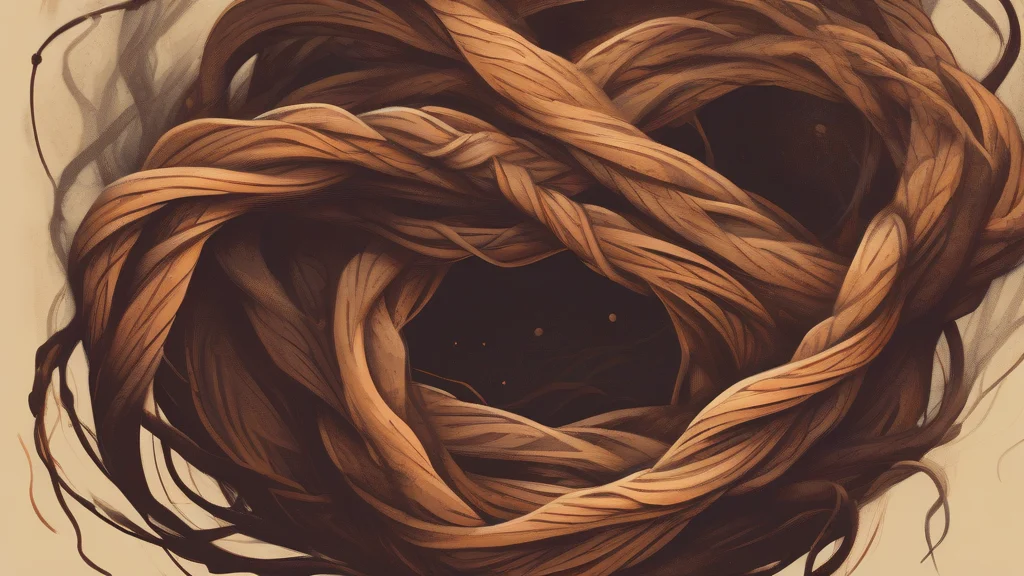
What does gnarl mean?
Gnarl is a compact English word with several closely related uses. As a noun, it means a hard knot or knotted mass, especially in wood; as a verb, it means to twist, knot, or contort something; and as an adjective, it describes something rugged, twisted, or difficult to handle. A gnarled branch and gnarled fingers therefore suggest images of irregularity rather than smooth regularity. The word also has an older sense connected with growling or snarling, which helps explain its sound and its association with harsh, tangled forms. In modern English, “gnarl” itself is literary and somewhat uncommon, while “gnarled” is familiar in descriptions of weathered trees and rough hands, and “gnarly” is especially common in informal American usage. The word is memorable because it moves easily among a physical knot, a twisting action, and a quality of rugged complexity. It is also especially useful for describing things that are irregular rather than merely rough: a gnarled surface has curves and knots built into its form.
A hard knot or swollen, knotted mass in wood or similar material.
"A dark gnarl ran through the center of the old tabletop."
Chiefly literary; the plural is uncommon.
To twist, knot, or contort into a tangled or irregular form.
"Centuries of wind had gnarl the trunk into a massive spiral."
Often used intransitively or in literary descriptions of weathered wood, ropes, and similar materials.
Twisted, knotted, or ruggedly irregular.
"The narrow path was gnarl with roots and loose stones."
Less common than the derived form “gnarled.”
The plural is grammatically regular but rare in modern usage.
"The carpenter mapped the gnarls before cutting the beam into lengths."
A gnarl began as a knot in wood; “gnarled” preserves that image, while “gnarly” turns it unmistakably informal.
Reviewed by Deb Chak, Editor. AI-assisted content curated by RJS Tech Solutions LLP.
Where does gnarl come from?
The noun developed from an Old English word meaning a knot or knotty wood, while the verb has a parallel Germanic history associated with snarling or growling. Middle English forms helped establish the modern spelling, and the word belongs to a family that also includes Old Norse knarr, meaning a knot or rough wood. Its later senses for twisting, knotting, and rugged irregularity developed naturally from the image of a hard knot in wood.
Related word forms
How gnarl is actually used
The word is literary and somewhat uncommon in modern English. “Gnarled” is more familiar in descriptions of weathered trees and rough hands, while “gnarly” is especially common in informal American usage.
Easily confused with gnarl
Both can describe a tangle, but gnarl is chiefly a knot or an act of twisting, whereas snarl primarily means to growl and, as a noun, a tangled mass.