
What does gnarled mean?
Gnarled describes something conspicuously twisted, knotted, or irregular, most often a tree trunk, branch, root, or hand. Its strong visual association with old, weathered wood gives the word a broader figurative force: a gnarled path may be difficult to follow, and gnarled negotiations may be tangled and hard to resolve. The adjective can also convey ruggedness and character, as in the familiar image of a gnarled old tree. It is especially useful when precise alternatives such as “twisted” or “knotted” do not capture the combination of irregularity, age, and roughness that the word suggests. In formal writing, gnarled is effective for vivid description, though it may sound more literary than neutral when applied to abstract subjects. The related verb “gnarl” means to become or make twisted and knotted.
Twisted, knotted, or irregular in shape; figuratively, rugged, weathered, or complicated.
"A gnarled branch reached across the path like a fallen beam."
The physical sense is the most common; figurative senses extend the impression of irregularity and difficulty.
To become or make twisted or knotted.
"The old ropes gnarled around the capstan."
This is the past tense and past participle of “gnarl,” and usually describes wood, rope, or another material becoming twisted.
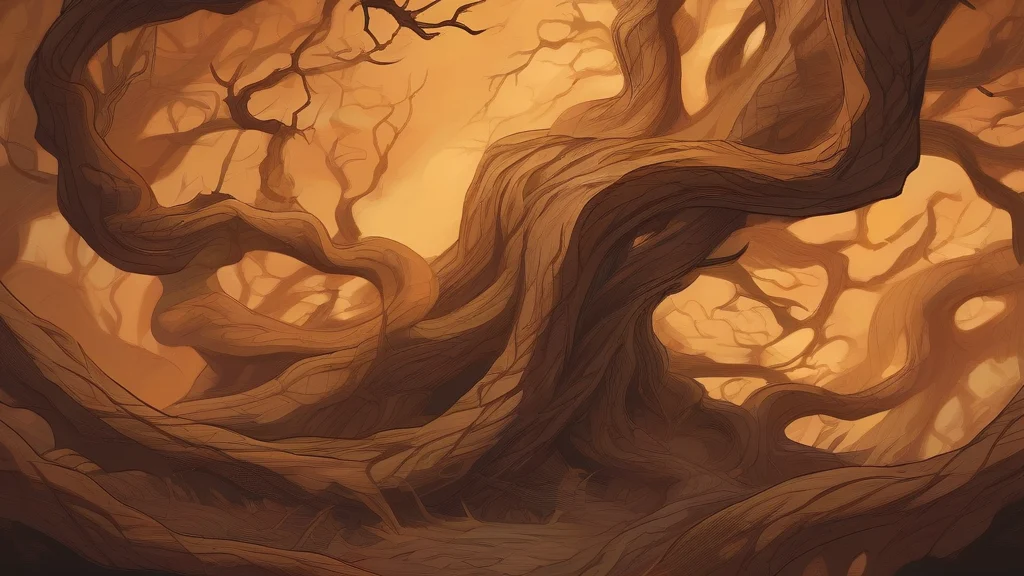
Gnarled gives a tree the voice of age: every twist in the wood becomes a visible mark of time.
Reviewed by Deb Chak, Editor. AI-assisted content curated by RJS Tech Solutions LLP.
Where does gnarled come from?
English “gnarled” developed from the verb “gnarl,” meaning to twist or knot, with the ending “-ed.” The base is also represented in older English variants such as “gnar” and “knarl,” which reflect the same native vocabulary rather than a separate borrowing from Latin or Greek. The adjective was established by the early 17th century and has long been particularly associated with the irregular forms of trees and weathered wood.
How gnarled is actually used
The word is chiefly descriptive and is especially associated with trees and weathered natural forms. Its figurative uses suggest complexity, difficulty, or a character shaped by long experience. It is common in both British and American English.
Easily confused with gnarled
Gnarled describes something physically twisted or knotted, whereas gnarly more often means rough, unpleasant, or difficult.