
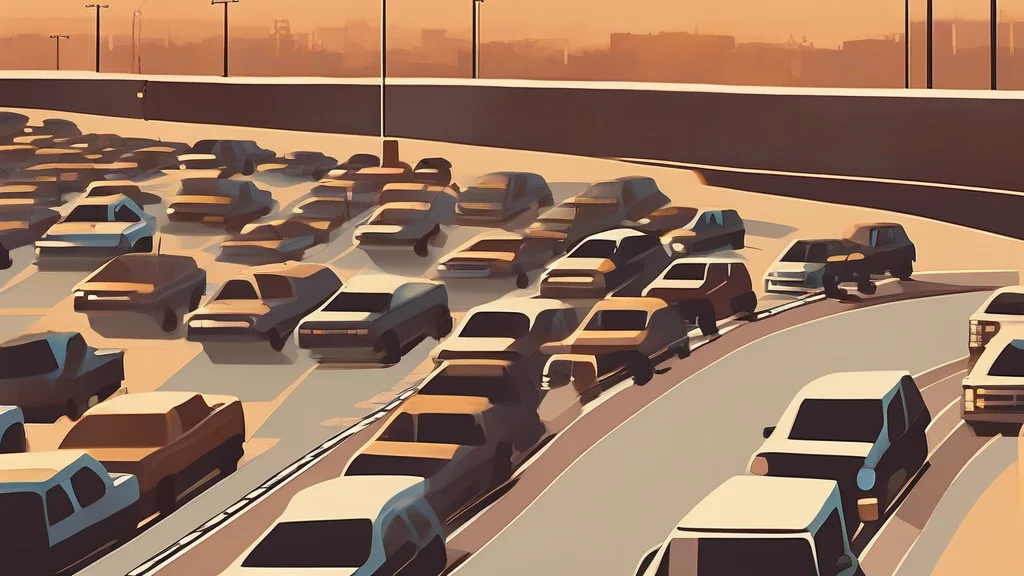
What does gridlock mean?
Gridlock is a noun for a situation in which traffic comes to a complete standstill, especially when vehicles at an intersection block one another. The word also describes a broader deadlock in politics, negotiations, administration, or business, where competing interests prevent any progress. In everyday use, “traffic gridlock” evokes a frustrating scene of stationary vehicles, while expressions such as “political gridlock” suggest institutional paralysis. The word is recognizable in British and American English and is used in both formal reporting and casual conversation. Its power comes from combining two concrete ideas: a grid, suggesting intersecting lines or roads, and a lock, suggesting something held fast. This makes gridlock especially effective for describing circumstances in which many participants are involved but none can move. It is a useful word whenever the obstruction is complete, tangled, and difficult to resolve.
A complete blockage of traffic caused by vehicles obstructing one another; figuratively, a deadlock that prevents progress.
"The accident caused gridlock across the city for several hours."
Often used figuratively for political, administrative, or business situations in which no agreement or action is possible.
To become stuck in a gridlock, especially as traffic; to cause traffic or an activity to become completely obstructed.
"The narrow bridge can gridlock when too many vehicles arrive at once."
Most often used intransitively with traffic as the subject; it can also be used transitively in formal or figurative contexts.
The noun is more commonly used in the uncountable sense, but the countable plural is standard, especially for separate episodes of complete obstruction.
"Several gridlocks disrupted the morning commute."
Gridlock turns an ordinary crossing of roads into a standstill—and gives us a memorable metaphor for any situation in which nobody can move.
Reviewed by Deb Chak, Editor. AI-assisted content curated by RJS Tech Solutions LLP.
Where does gridlock come from?
Gridlock is an English compound formed in the early 20th century from “grid” and “lock.” Its literal meaning developed from the arrangement of streets and railway lines and the resulting obstruction of vehicles, while the figurative use soon extended the idea to political and organizational deadlock. “Grid” is related to older words such as “gridiron” and “griddle,” and “lock” comes from the longstanding English root meaning a fastening or fastening device.
Related word forms
How gridlock is actually used
The term is common in formal reporting as well as informal speech. Its literal traffic sense is now frequently extended to describe political, administrative, or industrial obstruction; “gridlock” often suggests mutual blockage rather than a problem caused by one party alone.
Easily confused with gridlock
Gridlock originally describes traffic in which intersecting roads become completely blocked, while deadlock is the broader term for any situation in which opposing parties prevent progress.