
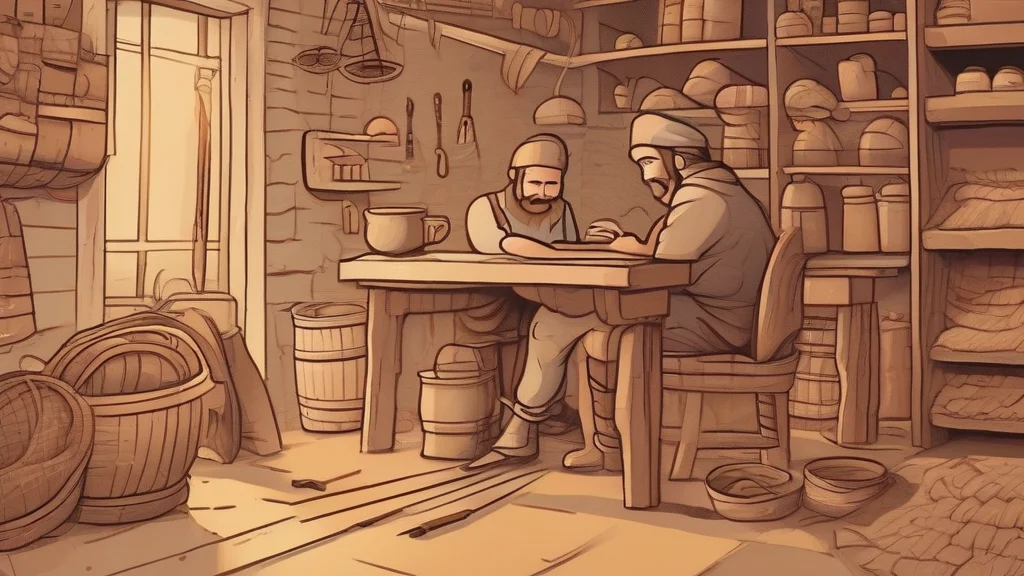
What does handicraftsmen mean?
Handicraftsmen is the plural of handicraftsman and denotes skilled workers who make objects by hand, whether functional tools, decorative pieces, or other crafted goods. The term is especially associated with traditional trades such as woodworking, pottery, weaving, and metalwork, although it can also describe contemporary makers working with modern tools and techniques. In everyday use, handicraftsmen conveys manual skill, close attention to materials, and pride in the finished object. The expression can sound somewhat traditional or old-fashioned, and craftspeople is often preferred as a gender-neutral alternative in mixed-gender groups. Historically, however, the word's gendered ending is embedded in a much older craft tradition. It remains useful in descriptions of local artisans, heritage crafts, and small-scale production, where it highlights the human skill behind an object as well as its practical function.
noun, pluralHandicraftsmen are skilled workers who make useful or decorative objects by hand, especially in traditional trades.
- Skilled workers who make objects by hand, especially those engaged in traditional or decorative crafts.
"The village's handicraftsmen preserved centuries-old techniques in their carved furniture and woven textiles."
"Local handicraftsmen supplied the market with pottery, baskets, and hand-tooled wooden furniture."
"Her grandfather was one of the handicraftsmen commissioned to restore the cathedral's stained glass."
This is the standard plural of handicraftsman, changing the final -man to -men while retaining the -s before it.
"The master handicraftsmen demonstrated their trade at the annual heritage festival."
The plural handicraftsmen hides a double change: an -s joins the base before the -man ending becomes -men.
Reviewed by Deb Chak, Editor. AI-assisted content curated by RJS Tech Solutions LLP.
Where does handicraftsmen come from?
The noun handicraftsman was formed from handicraft, a compound that developed from Middle English handcraft, with Old English handcræft behind it. Its elements literally combine the hand with a craft or skill, reflecting manual work done with the hands. The plural handicraftsmen retains the historical -man ending and adds the regular plural -s before it, a pattern also seen in craftsmen.
Related word forms
How handicraftsmen is actually used
The term is conventional but explicitly gendered. In mixed-gender groups, craftspeople is often preferred, while artisans may carry a more traditional or prestige-oriented connotation.