
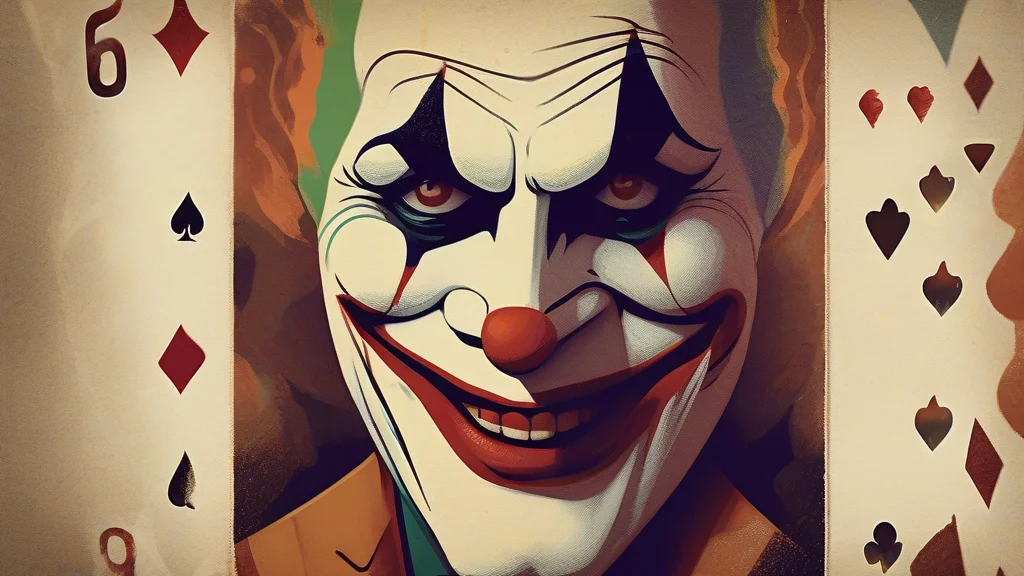
What does joker mean?
A joker is most commonly a special playing card traditionally shown as a jester and traditionally ranking below the ace but above the other numbered cards. In informal British and American English, it can also describe a playful, mischievous, or teasing person. Such a person may be regarded as humorous and lively, although the word can imply that their seriousness should not be taken at face value. The expression “the joker in the pack” refers to an unpredictable element that may disrupt a situation or an arrangement. The word also extends figuratively to people or things whose behaviour is eccentric, surprising, or capable of changing the tone of an occasion. Although a joker is associated with a jester, the words are not interchangeable in every context: a jester was traditionally a professional entertainer, while a joker is now more commonly a card or a mischievous person.
A playing card, traditionally bearing the figure of a jester and usually carrying the highest value except the ace.
"The player discarded the joker and took the remaining cards."
In card games, “joker” is a standard term for a special card that may stand in for another card or have special rules depending on the game.
A mischievous, playful, or teasing person.
"The children behaved like a group of jokers all afternoon."
This informal sense is common in British and American English and may suggest that someone is not to be taken too seriously.
The plural is used for multiple playing cards or multiple people described as jokers.
"The deal included two jokers, and both players laughed when the first one was played."
The joker began as the card that could overturn the rules of a hand, and it still carries the mischievous idea of turning a serious situation upside down.
Reviewed by Deb Chak, Editor. AI-assisted content curated by RJS Tech Solutions LLP.
Where does joker come from?
The word comes from Middle English usage connected with jesting and foolishness, with its precise early origin traditionally associated with the idea of a fool or jester. The modern playing-card sense developed from the card’s traditional representation of a jester. The word is related to “joke” and to the wider family of English words derived from Latin roots associated with jesting and merriment.
Related word forms
How joker is actually used
In British and American English, “joker” is informal when describing a person and may suggest that someone is clever, playful, or fond of teasing. In cards, it is a standard technical term. The word can also carry the implication of being unreliable or not serious.
Easily confused with joker
A jester was a court entertainer who performed humorous or comic acts, whereas a joker is primarily a playing card or, in modern usage, someone who behaves playfully or teasingly.