
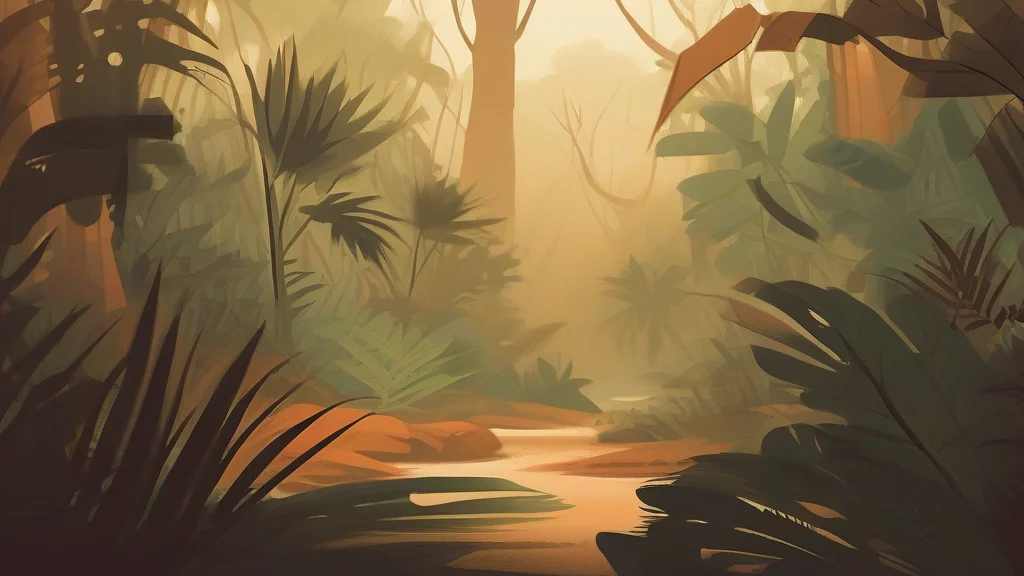
What does jungly mean?
Jungly means resembling a jungle, especially through dense, tangled, and luxuriant vegetation. The adjective is often applied to undergrowth, gardens, forests, or other landscapes that have become difficult to penetrate because plants have grown thickly and unevenly. Its use is informal and descriptive, conveying both visual abundance and a sense of untamed wilderness. Figuratively, jungly can characterize people, situations, or creative works as chaotic, overgrown, or intricately complicated. The word combines the familiar concept of the jungle with the suffix “-y,” making it more immediate and evocative than a phrase such as “jungle-like.” It is particularly useful when an entry needs to capture vegetation that feels dense and unruly rather than merely green, and it can lend a vivid, slightly dramatic tone to descriptions of landscapes and environments.
adjectiveCharacterized by dense, tangled, luxuriant vegetation resembling a jungle. It can also describe land that is wild, overgrown, or difficult to penetrate.
- Resembling a jungle, especially in being densely overgrown, tangled, or luxuriant.
"They followed a narrow path through the jungly undergrowth, pushing aside ferns and tangled vines."
"The tropical garden became almost jungly after years of neglect."
"Her jungly novel presents a world of tangled politics and hidden dangers."
Jungly is where the vegetation behaves as if it owns the place.
Reviewed by Deb Chak, Editor. AI-assisted content curated by RJS Tech Solutions LLP.
Where does jungly come from?
Jungly was formed in English by adding the suffix “-y” to jungle. Jungle entered English through French and Portuguese, with Portuguese jangal deriving from Sanskrit jāṅgala, a term for dry, scrubby, or wild land. The related Hindi form jāṅgal became the source of the modern English sense of dense tropical vegetation, and jungly developed as an adjective expressing the appearance of such terrain.
How jungly is actually used
Informal and descriptive rather than strictly technical. It is most often applied to vegetation or landscape but can also be used figuratively for something wild, complex, or difficult to navigate.
Easily confused with jungly
Jungly describes dense, wild, tangled vegetation, whereas jingly describes a light, tinkling or ringing sound.
Jungle is a noun referring to dense vegetation or wilderness, while jungly is an adjective describing something that resembles a jungle.