
What does leopard mean?
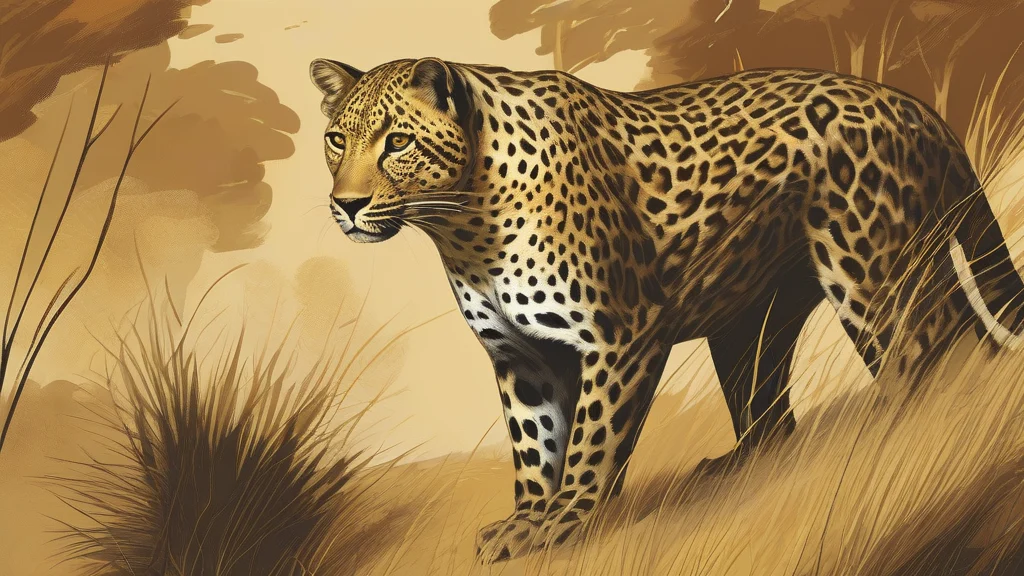
A leopard is a large wild cat recognized by its powerful build, retractable claws, and spotted or rosette-patterned coat. The species occurs across Africa and parts of Asia and is known for its adaptability, climbing ability, stealth, and powerful, killing bite. Although often loosely associated with the term “panther,” a leopard is a distinct species, and it should not be confused with the faster cheetah or the heavier jaguar. In everyday language, “leopard” can also refer to a leopard-skin pattern, especially in clothing, textiles, and decorative design. The word is consequently both a precise zoological term and a familiar visual description.
nounA large, muscular wild cat native to Africa and Asia, typically having a golden or tawny coat covered in dark spots. A leopard is a highly adaptable predator, and the name is also used for its spotted coat or patterns resembling it.
- A large spotted wild cat of the cat family, found in Africa and Asia.
- The spotted coat or a pattern resembling that coat of a leopard.
- A heraldic leopard, traditionally depicted with spots, though heraldic conventions may differ from the animal’s natural appearance.
"The leopard moved silently through the tall grass, its spotted coat blending with the dappled light."
"A leopard was spotted near the edge of the reserve at dusk."
"She wore a coat with a bold leopard-print pattern."
The regular plural is used when referring to multiple animals.
"Several leopards were observed in the remote hills."
A leopard’s spots are not simple dots: they are often clustered into rosettes, giving its coat the appearance of a living constellation.
Reviewed by Deb Chak, Editor. AI-assisted content curated by RJS Tech Solutions LLP.
Where does leopard come from?
The English word descends through Latin from Greek forms referring to a large spotted cat. Its precise ancient development is uncertain, but the name has traditionally been associated with Greek elements meaning “lion” and “pard,” the latter denoting a spotted big cat. Medieval Latin forms such as leopardus established the modern English spelling, while the related English words pard, pardal, and pardine preserve elements of the same lexical tradition.
Related word forms
How leopard is actually used
The word is normally used for the animal and for its characteristic spotted appearance. In heraldry, “leopard” refers to a spotted beast and does not necessarily indicate a zoologically accurate depiction.
Easily confused with leopard
A leopard is generally stockier and has rosettes, while a cheetah is slimmer, has solid round spots, and is known for its speed.
Leopards and jaguars are different big cats: leopards are generally smaller and have rosettes with central spots, while jaguars are more robust and often have rosettes containing smaller spots.