
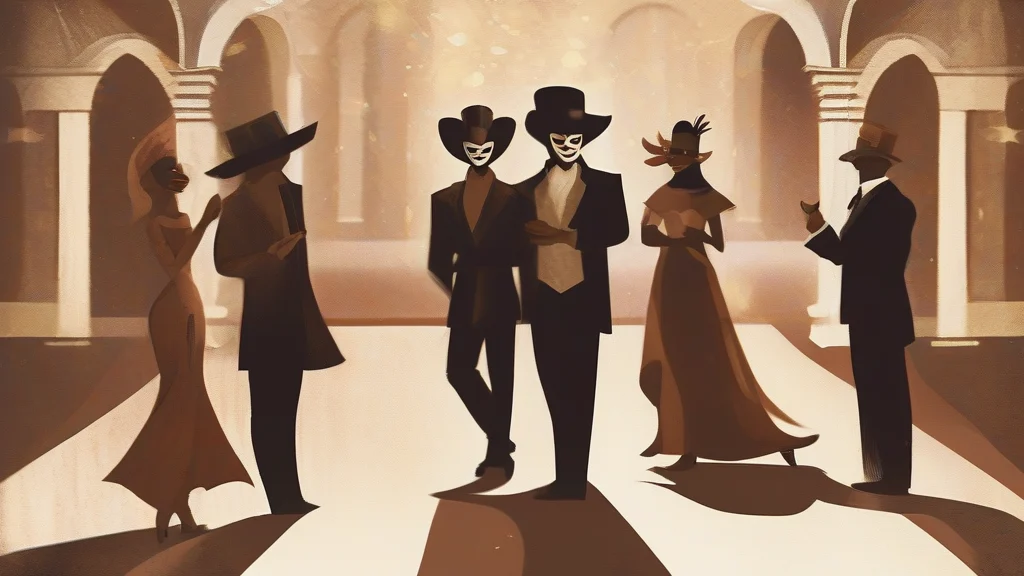
What does masquerade mean?
A masquerade is, literally, a gathering where people wear masks or costumes, traditionally associated with balls, theatrical festivities, and disguise. In figurative use, it describes a false appearance or pretense, as when a person presents a deceptive identity or an organization makes itself seem more trustworthy or beneficial than it really is. The verb “masquerade” usually appears with “as”: someone or something masquerades as a person, institution, or thing it is not. The word can therefore describe both playful social role-play and serious deception, although its figurative uses often suggest concealment and mistrust. Its historical connection with masked ceremonies makes it especially vivid for situations in which outward appearances conceal the reality beneath them.
A social event at which participants wear masks or costumes; also, a deceptive disguise or false appearance.
"The palace hosted a masquerade attended by nobles in elaborate costumes."
The figurative sense is formal and often implies deception or concealment of identity.
To pretend to be someone or something one is not, or to pass oneself off under a false identity or guise.
"The accused executive masqueraded as an independent investigator."
Commonly used with “as”; the word carries a connotation of deliberate deception.
The plural is used for social events, deceptive disguises, and instances of pretending to be something else.
"The novel describes several masquerades held in remote country houses."
From masked balls to political deception, a masquerade has always concealed the person beneath the performance.
Reviewed by Deb Chak, Editor. AI-assisted content curated by RJS Tech Solutions LLP.
Where does masquerade come from?
The word entered English in the early 17th century from French “masquerade,” a borrowing of Italian “mascherata,” meaning a masked ball or disguise. Italian “mascherata” is related to “maschera,” meaning mask, and ultimately to the broader language of masks and masquerades. The English noun and verb developed from this sense of masking and disguising, later extending metaphorically to false identities and pretense.
Related word forms
How masquerade is actually used
The noun is formal and can refer both to a masked social event and metaphorically to a deceptive appearance. The verb commonly takes “as”: “masquerade as” someone or something.
Easily confused with masquerade
A masquerade is a disguise or false persona, whereas mascara is cosmetic coloring applied to the eyelashes.