
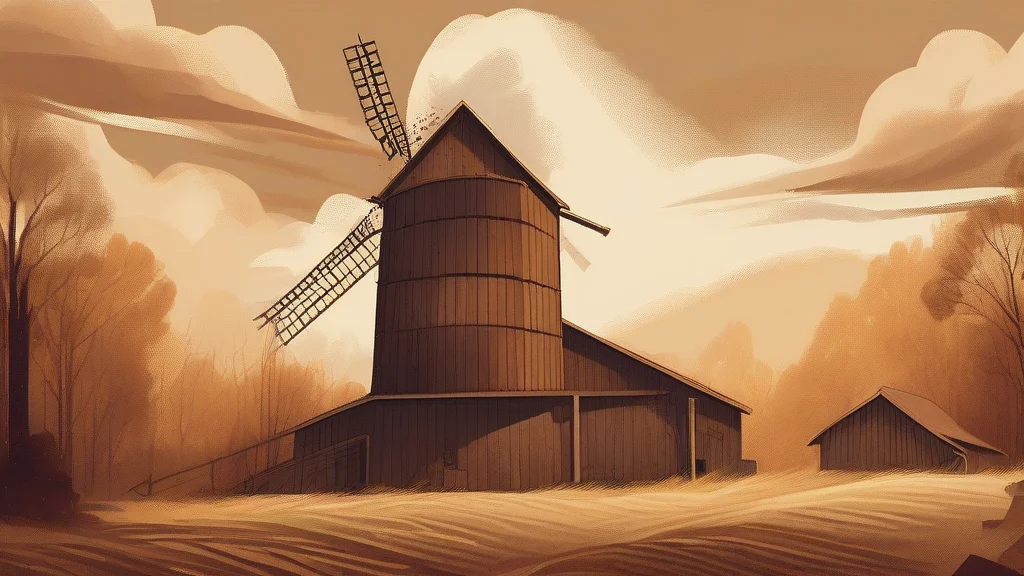
What does mill mean?
A mill is a machine or building used to grind grain and process other materials, traditionally through water, wind, animal power, or steam. The word may refer specifically to the grinding machinery, to the building that houses it, or more broadly to a factory or industrial works. As a verb, “mill” means to grind material in such a facility, but it also describes people moving restlessly in a crowd. The term carries a strong sense of traditional mechanical production, especially through images of watermills, windmills, and millstones, although modern mills are also important in industries such as steel, paper, and food processing. Related expressions such as “put through the mill” use the word metaphorically for undergoing a demanding or difficult experience. “Milling around” similarly suggests a crowd moving without direction or purpose.
A machine, building, or industrial establishment that grinds grain or processes other materials.
"The village mill was converted into a museum after the last miller retired."
The sense can be narrowed to the machine, broadened to the building, or extended to a larger industrial works.
To grind or process material in a mill; also, to move around restlessly in a crowd.
"The blades milled through the frozen snow."
The crowd-related use is informal and is usually expressed as “mill about” or “mill around.”
Used for multiple machines, buildings, or industrial establishments.
"Several historic mills line the riverbank."
Before electricity, wind and flowing water did the grinding; today, the word still evokes a simpler machine turned by the weather.
Reviewed by Deb Chak, Editor. AI-assisted content curated by RJS Tech Solutions LLP.
Where does mill come from?
The English word descends from Old English mylen, meaning a mill or the business of grinding grain. It was borrowed during the period of Old English from a Germanic ancestor related to forms found in other Germanic languages and ultimately connected with the Latin molina, a mill. The same Latin grinding root also underlies English “molar,” while occupational and compound derivatives include “miller” and “millstone.”
Related word forms
How mill is actually used
The noun can denote the machine itself, the building housing it, or the larger industrial establishment. The verb is formal when describing processing material, while “mill about” or “mill around” is informal and denotes restless movement within a crowd.