
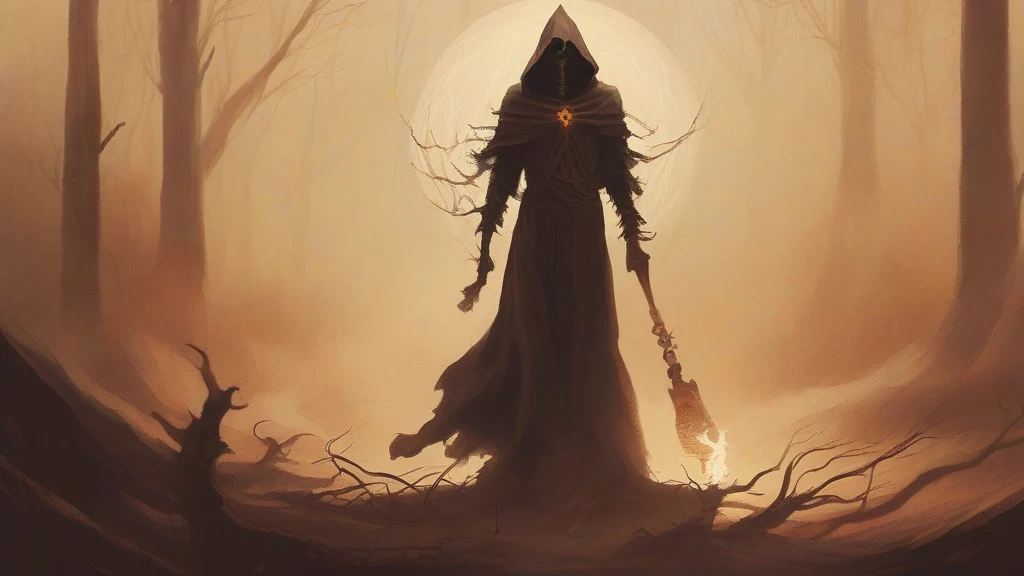
What does necromancer mean?
A necromancer is a person who practices necromancy, the use of magic to communicate with the dead or, in many traditional and fictional accounts, to raise or animate the dead. In ordinary modern English, the term occurs most often in fantasy literature, games, and other stories where a practitioner may be an enemy, mentor, or powerful and unsettling antagonist. Its older cultural associations include the ancient Greek practice of consulting the spirits of the dead, although the modern word was formed through Latin and French rather than directly from Greek. The word carries a strong suggestion of danger, moral transgression, and contact with what lies beyond ordinary human experience. It is therefore more specific than the general terms “magician” or “sorcerer”: the defining feature is the dead. In cautious or historical prose, “necromancer” may name a learned practitioner of divination, while in contemporary fantasy it often labels a specialist in raising undead creatures. Both usages depend on an imaginative conception of the dead as knowable or controllable, which gives the word its lasting literary power.
nounA person who practices necromancy, especially one who is believed to summon or communicate with the spirits of the dead. In folklore and fantasy, the term often denotes a magician who raises or animates the dead.
- A practitioner of necromancy, especially a person believed to summon or communicate with the spirits of the dead.
- In fantasy and folklore, a mage whose special power is to raise or animate the dead.
"An ancient necromancer had been summoned to the ruined castle."
"The necromancer traced another sigil as the candles began to gutter."
"In the game, players can recruit a necromancer to lead their undead army."
The standard plural used when referring to multiple practitioners of necromancy.
"Ancient necromancers guarded the entrance to the forbidden archive."
The word hides two Greek ideas: nekros, meaning “dead,” and manteia, meaning “divination.”
Reviewed by Deb Chak, Editor. AI-assisted content curated by RJS Tech Solutions LLP.
Etymology of necromancer
The word entered English in the early 17th century from French nécromancien. It reflects Medieval Latin necromantia and Greek nekromanteia, formed from nekros, meaning “dead,” and manteia, meaning “divination.” The English family also includes necromancy and necromantic, while the Greek root nekros underlies compounds such as necrology and necrosis.
Related word forms
How necromancer is actually used
The word is chiefly literary and used in historical, occult, folklore, and fantasy contexts. It commonly carries threatening or morally transgressive connotations, and it is not usually used for an ordinary magician.
Easily confused with necromancer
A necromancer is the person who performs necromancy; necromancy is the practice of using magic to communicate with or raise the dead.