
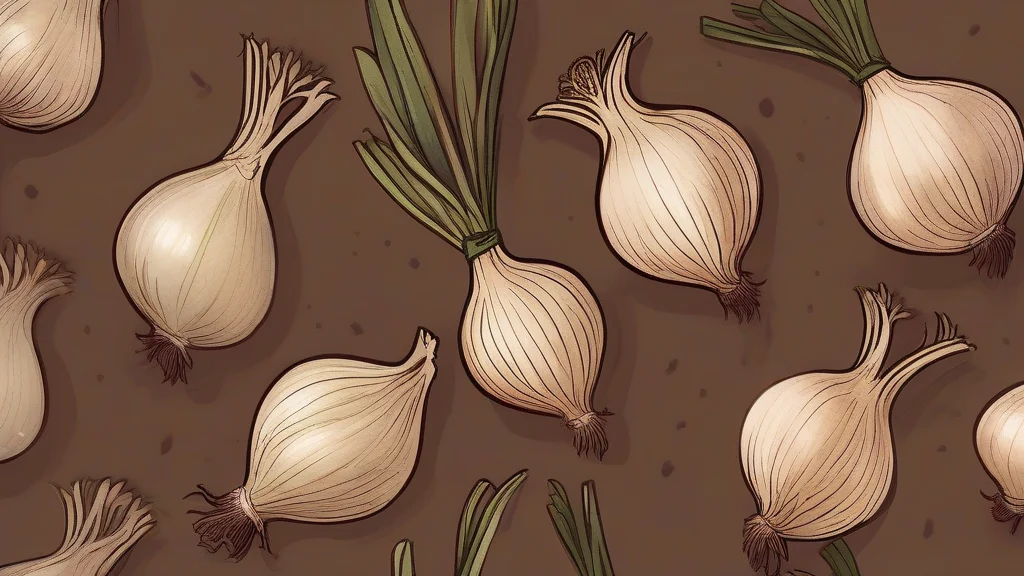
What does onion mean?
An onion is the edible bulb of a cultivated plant of the genus Allium, especially Allium cepa. Its layered structure, strong flavor, and ability to caramelize make it a foundational ingredient in cuisines worldwide, appearing in soups, stews, salads, sauces, and many cooked dishes. In everyday speech, “onion” usually means the bulb rather than the entire plant, though the word can also refer to the plant itself. The flavor ranges from mild and sweet to sharp and pungent depending on the variety and preparation. Chopping or slicing releases compounds that irritate the eyes and nose, while cooking softens the flavor and develops sweetness. Onion is also widely used in idioms and informal metaphors, especially expressions associated with causing tears or unpleasant surprises. It is a highly versatile word because it names both an ordinary food and a culturally familiar vegetable with distinctive sensory properties.
The edible bulb of the onion plant, used as a vegetable, seasoning, or ingredient in cooking.
"The sauce is flavored with onion and garlic."
This is the dominant everyday sense. When referring to the plant itself, the word may be used without preparation-related context.
Any of several plants related to the cultivated onion, including plants with bulbs, leaves, or rhizomes used as vegetables or herbs.
"The garden contains several kinds of onion, including bunching varieties."
This broader botanical sense is more common in horticultural, agricultural, or specialist contexts.
The regular plural is used for individual bulbs or plants, as well as for onions as a food ingredient.
"Buy two onions and a bunch of fresh parsley."
The onion's layered bulb is a botanical time capsule: its dry outer scales protect the growing shoot and the fleshy leaves that store nutrients.
Reviewed by Deb Chak, Editor. AI-assisted content curated by RJS Tech Solutions LLP.
Where does onion come from?
The English word comes through Old French oignon, which was borrowed from Latin ūniōnem, a diminutive related to ūnus, meaning “one.” The onion's layered bulb was traditionally interpreted as resembling nested rings, which may have contributed to the word's association with unity. English inherited the term through Anglo-French and Middle English, with the modern form established by the early modern period. Related words such as union, unity, unison, and unite ultimately share the same Latin root.
How onion is actually used
In general usage, “onion” most often refers to the edible bulb. “Green onion” is a regional term for a small, mild onion harvested young, while “spring onion” is common in British English. “Onion” can also refer metaphorically to a person who makes others cry, though this use is informal and sometimes dismissive.
Easily confused with onion
An onion is a mature bulb-forming plant, whereas a scallion is generally a slender green onion harvested young.