
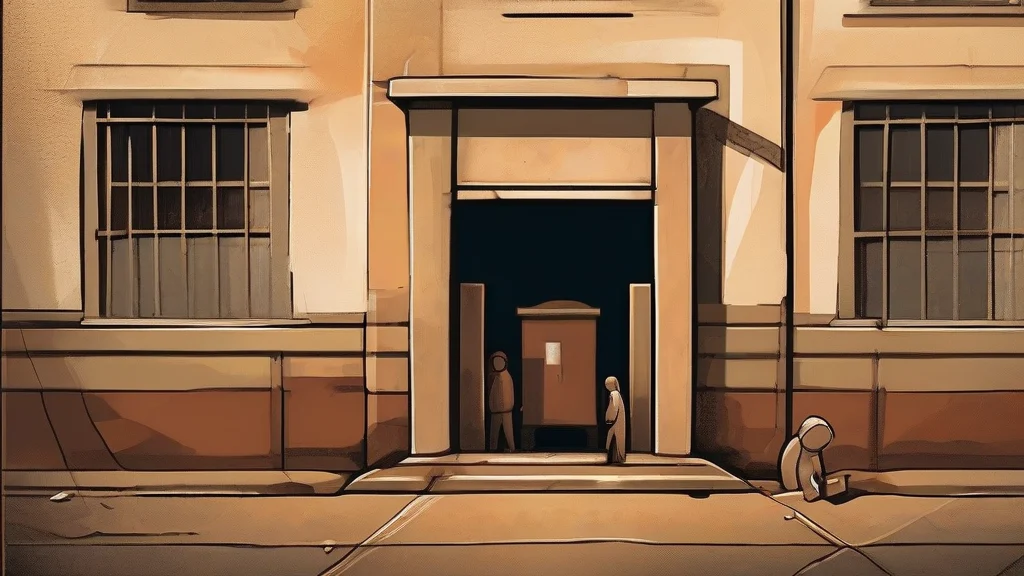
What does poorhouse mean?
A poorhouse was an institution maintained by a parish or local authority to provide accommodation, food, and basic care for people who lacked sufficient means to support themselves. In England and Wales, poorhouses were closely associated with the workhouse system, under which residents commonly worked for the institution in exchange for maintenance. The system could provide relief in emergencies, but it was also associated with institutional conditions, enforced work, and the separation of families. The word is now chiefly historical, though it survives in figurative use for a place of extreme hardship or dependence on public assistance. In that sense, it emphasizes both material poverty and the loss of personal autonomy. Although the term is sometimes used interchangeably with workhouse, poorhouse more specifically highlights the housing of poor people and their reception of institutional support.
nounA public institution, especially in England and Wales, where people without adequate means were housed and maintained, often in exchange for work. The term is chiefly historical and is also associated with the English workhouse system.
- An institution maintained by public or parish funds to house people who were poor, often requiring them to work.
- By extension, a place or condition regarded as a harsh form of public poor relief.
"The family was reduced to seeking refuge in the local poorhouse."
"After losing his job, he found himself in the poorhouse."
"Local officials debated whether the parish should reopen the poorhouse."
"For many families, admission to the poorhouse meant a complete loss of independence."
The plural is used when referring to multiple institutions or examples of the institution.
"Several poorhouses operated within the surrounding parishes."
Before modern welfare states, the poorhouse was one of society’s harshest safety nets—and often one of its most feared.
Reviewed by Deb Chak, Editor. AI-assisted content curated by RJS Tech Solutions LLP.
Etymology of poorhouse
The word combines the older English adjective poor with house and was used for institutions housing people supported by public or parish funds. Poor ultimately comes through French from Latin pauper, meaning “poor” or “destitute,” while house has Germanic ancestry. The compound became especially prominent in discussions of the English poor-law and workhouse systems before the rise of modern social welfare.
Related word forms
How poorhouse is actually used
The term is chiefly historical and is used especially in discussion of the English and Welsh poor-law system. It can sound archaic or deliberately harsh when used figuratively, and may appear in literature concerned with poverty and social conditions.
Easily confused with poorhouse
A workhouse was a broader institution where poor people received accommodation and work in exchange for basic maintenance, whereas poorhouse more specifically emphasizes housing people who were poor.
An almshouse was generally an endowed charitable residence for elderly or needy residents, while a poorhouse was generally a public institution for people without sufficient means.