
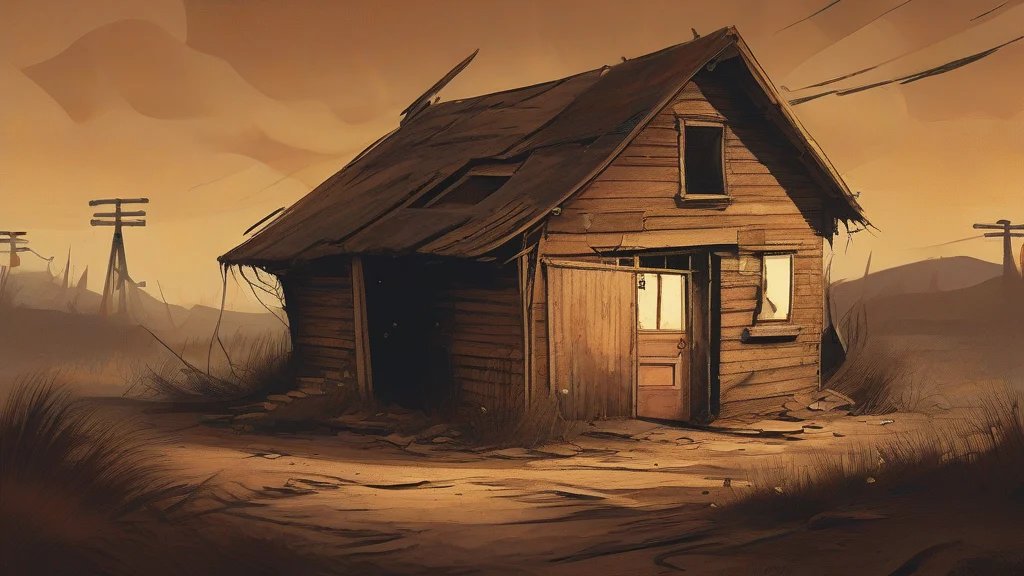
What does ramshackle mean?
Ramshackle describes something that is in poor repair, loosely constructed, or conspicuously run-down. The word is especially associated with old buildings, vehicles, and other structures whose deterioration is plainly visible, but it can also describe systems or arrangements that seem disorganized and insecure. It often conveys not merely age but neglect: a ramshackle house may have sagging boards, broken windows, and a failing roof. The term can sound slightly humorous or exaggerated rather than clinically precise, which makes it useful for vivid descriptive writing. In figurative use, it emphasizes disorder, instability, or poor maintenance. Its meaning is stable in standard modern English and is readily understood in both British and American usage.
adjectiveIn poor condition, especially as a result of age, neglect, or general disrepair. It can also describe something loosely constructed or badly organized.
- In a state of poor repair or dilapidation, especially because of age or neglect.
- Loosely or poorly constructed, arranged, or organized.
"The family lived in a ramshackle cottage at the edge of the village."
"The old warehouse had a ramshackle roof that leaked whenever it rained."
"The committee criticized the department's ramshackle system for keeping incomplete records."
Ramshackle describes a place or object that has not simply aged gracefully—it has been allowed to come apart.
Reviewed by Deb Chak, Editor. AI-assisted content curated by RJS Tech Solutions LLP.
Where does ramshackle come from?
The word dates from the mid-19th century. Its precise historical derivation is not entirely clear, but it is commonly explained as a combination of elements associated with “ram” and “shackle,” or as related to “ramp” in the sense of a temporary structure. The historical variant “ransackle” also appears, and modern usage has settled on “ramshackle.”
How ramshackle is actually used
Usually carries a mildly negative or humorous tone. It is commonly used for buildings, vehicles, structures, and other physical objects, and can be extended figuratively to describe inefficient or disorganized arrangements.