
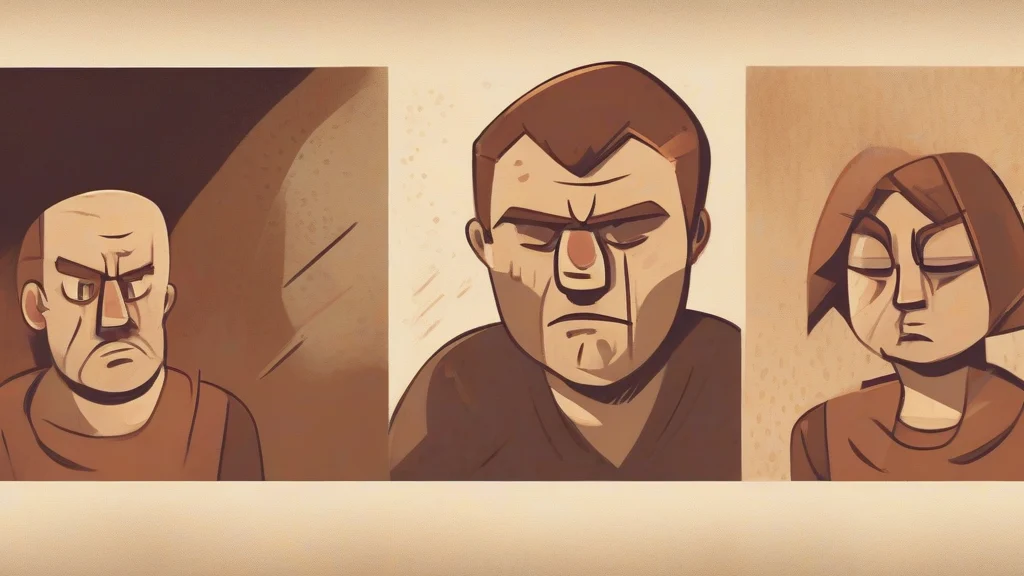
What does scowled mean?
“Scowled” means to have looked angry or displeased, usually by lowering the eyebrows and turning the corners of the mouth downward. It is the past tense and past participle of the verb “scowl.” The word describes a conspicuous facial reaction that communicates displeasure without requiring words, and it is often used with the preposition “at”: a person may “scowl at” another person, an object, or a proposal. “Scowled” generally conveys irritation, disapproval, or hostility rather than sadness or simple concentration. Although its grammatical forms are identical, the verb is standard in both British and American English. The related noun “scowl” names the facial expression itself, while “scowling” describes a sustained or habitual angry look. In writing, “scowled” is clearest when the visible expression and its emotional force are central to the sentence.
verb (past tense and past participle)To express anger or displeasure by lowering the eyebrows, frowning, and turning the corners of the mouth downward.
- To express anger or displeasure by making an angry facial expression, especially by frowning and turning the corners of the mouth downward.
"She scowled at the suggestion but offered no further comment."
"The customer scowled when the machine rejected her card."
"He scowled briefly, then relented and agreed to help."
Reviewed by Deb Chak, Editor. AI-assisted content curated by RJS Tech Solutions LLP.
Where does scowled come from?
The verb “scowl” was first attested in the early 17th century, and “scowled” is its regular past-tense form. Its precise ultimate origin is uncertain, so it is best treated as an English word rather than confidently traced to a particular foreign language. The longstanding meaning of “scowl” has centered on an expression of displeasure or anger.
Related word forms
How scowled is actually used
“Scowled” is the past tense and past participle of “scowl.” It describes a visible facial expression and is typically followed by “at” when the object of the anger or displeasure is stated.