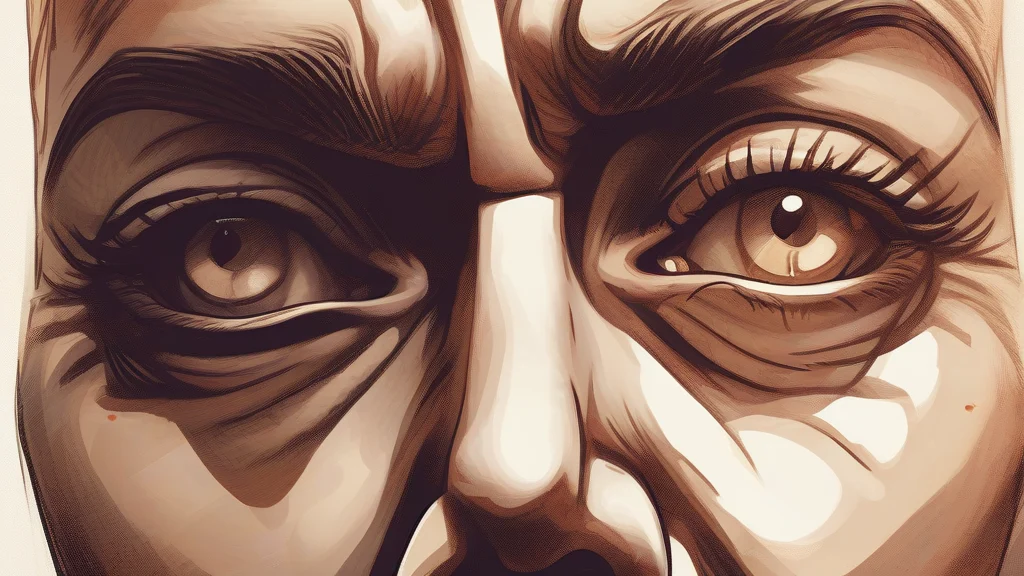
What does frowned mean?
"Frowned" is the past-tense form of "frown," one of the most universally recognized facial expressions in human communication. To have frowned is to have drawn the eyebrows together, wrinkling the forehead in a display of displeasure, disapproval, confusion, or deep concentration. The expression appears constantly in everyday life: a parent frowned at a messy room, an auditor frowned over suspicious figures, a reader frowned at a puzzling passage. Beyond its literal facial sense, the verb extends into a figurative social usage through the phrase "frowned upon," which denotes conduct that a community views with quiet disapproval even if no formal rule forbids it — smoking indoors, for instance, is now widely frowned upon. Because the frown requires no words and is interpreted consistently across cultures, it functions as a kind of universal signal, making "frowned" a compact and expressive way to convey judgment, concern, or skepticism in both speech and writing.
verbPast tense and past participle of "frown": to draw the brows together so as to wrinkle the forehead, typically expressing displeasure, disapproval, worry, or concentration.
- To draw the eyebrows together in a wrinkled expression of displeasure, disapproval, or concentration.
- (Less common) To regard something with disapproval or reluctance, as in 'the practice is frowned upon.'
"She frowned when she saw the unpaid bill on the kitchen table."
"The teacher frowned at the noise coming from the back of the classroom."
"Smoking in restaurants was once commonplace, but today it is widely frowned upon."
One raised brow may signal curiosity, but two lowered brows — a frown — are read as disapproval in virtually every human culture on Earth.
Reviewed by Deb Chak, Editor. AI-assisted content curated by RJS Tech Solutions LLP.
Etymology of frowned
The word traces back to the Old French "froignier" (also rendered "froigner"), meaning to snort or turn up the nose, which itself likely came from a Frankish Germanic source. It entered English in the late fourteenth century as "frownen," an Middle English verb, and gradually settled into the modern form "frown" with its inflected forms such as "frowned." The precise deeper origins are uncertain, though the association of nose-wrinkling and brow-knitting with disdain has persisted throughout its history.
Related word forms
How frowned is actually used
"Frowned" is almost always used in the past tense or past participle; the simple present uses the base form "frown." The phrase "frowned upon" carries a distinctly social meaning — signaling that a behavior, while not illegal, is socially disapproved — and appears frequently in formal writing about etiquette, business conduct, and regulation.
Easily confused with frowned
"Fawned" means showed servile flattery or affection (or, for a fawn, gave birth), while "frowned" means drew the brows together in disapproval — the two differ by one letter but mean nearly opposite behaviors.