
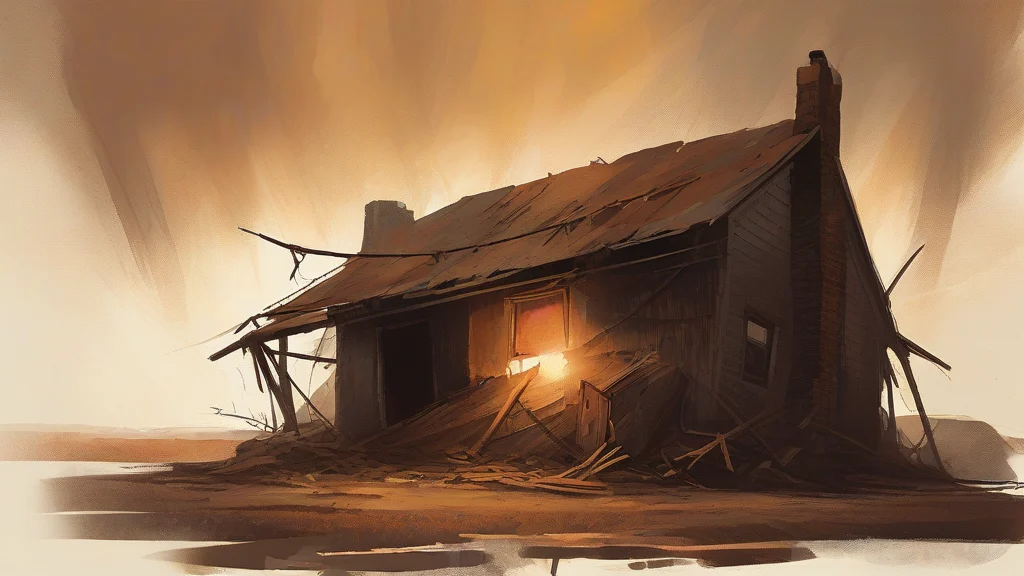
What does tumbledown mean?
Tumbledown describes a building, structure, or sometimes a district that is in such poor condition that it appears liable to collapse. The word is especially common in British English and often conveys more than simple age: a tumbledown property suggests long-term neglect, disrepair, and possibly poverty. It may be used literally for unstable structures or figuratively for places that appear worn, neglected, or close to ruin. In writing, it gives a concrete and strongly visual impression, making it more expressive than neutral words such as old or damaged. The adjective normally appears before a noun, as in “a tumbledown house,” although it can also be used predicatively. Because of its implications of structural weakness and social decay, it is a particularly evocative word in descriptions of housing, historic buildings, industrial sites, and deprived neighborhoods.
adjectiveIn a state of disrepair and likely to collapse, especially of a building or structure. It often also suggests prolonged neglect and poverty.
- In a state of severe disrepair, decay, or structural instability, especially of a building or other structure.
"The village consisted of a few tumbledown cottages clustered around an abandoned mine."
"They converted a tumbledown warehouse into bright apartments."
"The report described the school as tumbledown and in urgent need of repair."
Tumbledown paints a picture in a word: a structure is not merely old—it looks as though it could tumble down at any moment.
Reviewed by Deb Chak, Editor. AI-assisted content curated by RJS Tech Solutions LLP.
Where does tumbledown come from?
Tumbledown was formed in English from the verb tumble and the adverb down, with the sense of something that might fall or collapse. The compound developed during the early modern period, when it was commonly applied to deteriorating buildings. Tumble itself came into Middle English through Old French tomber, while down is a native English word; the deeper origin of the verb is uncertain. The related forms tumbling and tumbler also derive from the older verb.
How tumbledown is actually used
The word is especially common in British English but is also understood in American English. It is more vivid than merely saying that something is old and can carry broader connotations of neglect, poverty, or decay.