
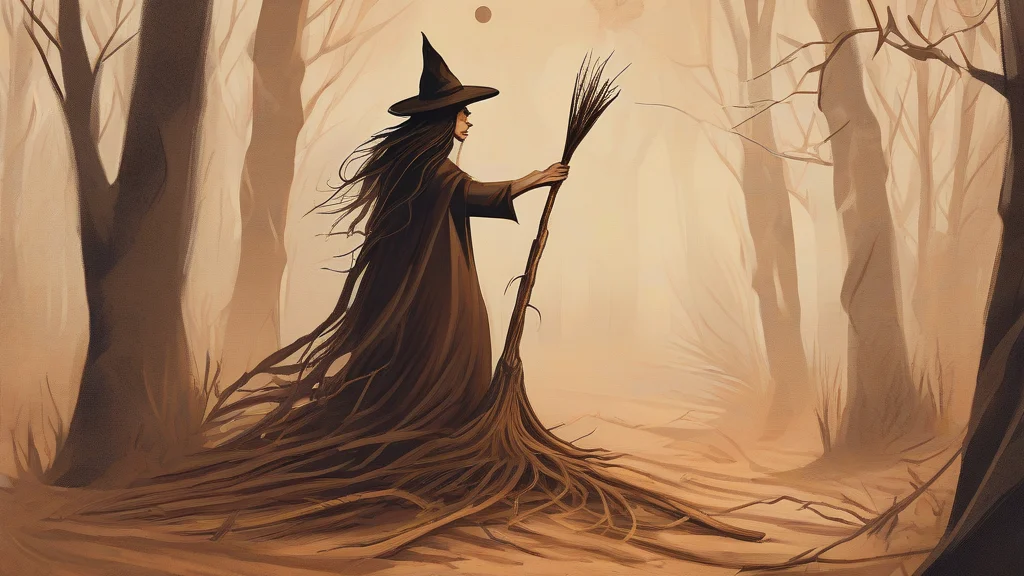
What does witchbroom mean?
Witchbroom is most often a botanical term for a dense, broom-shaped cluster of twigs that grows abnormally on a tree, commonly as a result of fungal disease. Such growths can be conspicuous on birches and other trees and are sometimes called witch's broom, witch broom, or witches' broom. Their unusual appearance, together with old beliefs that witches caused or used such growths, explains the name. In older and folkloric contexts, witchbroom can also denote a handmade broom of birch twigs, especially one imagined as belonging to a witch. Modern usage is mainly technical, including forestry, plant pathology, and gardening, where the term identifies a recognizable symptom rather than a species of plant. Outside specialist writing, the word carries an eerie, storybook association and is often used to add atmosphere to descriptions of gnarled woodland trees. It is a useful example of how folklore can preserve a label long after its original supernatural explanation has been replaced by scientific understanding.
nounA dense, broom-shaped mass of twigs growing abnormally on a tree, typically as a result of fungal infection; in older usage, a broom made from twigs, especially birch, associated with witches.
- A dense, broom-shaped cluster of abnormal twig growth on a tree, usually caused by a fungal pathogen.
- A broom made from twigs, especially birch twigs, imagined or traditionally associated with witches.
"A large witchbroom had swallowed half the crown of the old birch."
"The forest pathologist identified the distorted branches as a typical witchbroom caused by fungal infection."
"In the old story, the disguised witch left her witchbroom beside the road and entered the village on foot."
The standard plural is witchbrooms; the spelling witch's broom is also common in the traditional form.
"Several large witchbrooms were visible in the upper branches of the birch."
A tangled growth that looks like a broom was long blamed on witches—though the culprit is usually a fungus.
Reviewed by Deb Chak, Editor. AI-assisted content curated by RJS Tech Solutions LLP.
Etymology of witchbroom
The English compound witch-broom was recorded in the late sixteenth century for a broom made from twigs, especially birch twigs, associated with witches. The name subsequently became established for the abnormal, broomlike masses of twigs that develop on trees, growths that were popularly attributed to witches. Its components are inherited English words: witch, also the source of bewitch and witchcraft, and broom, the traditional implement made from twigs.
How witchbroom is actually used
The modern botanical term is also written witch's broom, witch broom, or witches' broom. It is chiefly used in forestry, plant pathology, horticulture, and descriptions of gnarled trees; outside technical contexts, it often has a mildly eerie or storybook association.