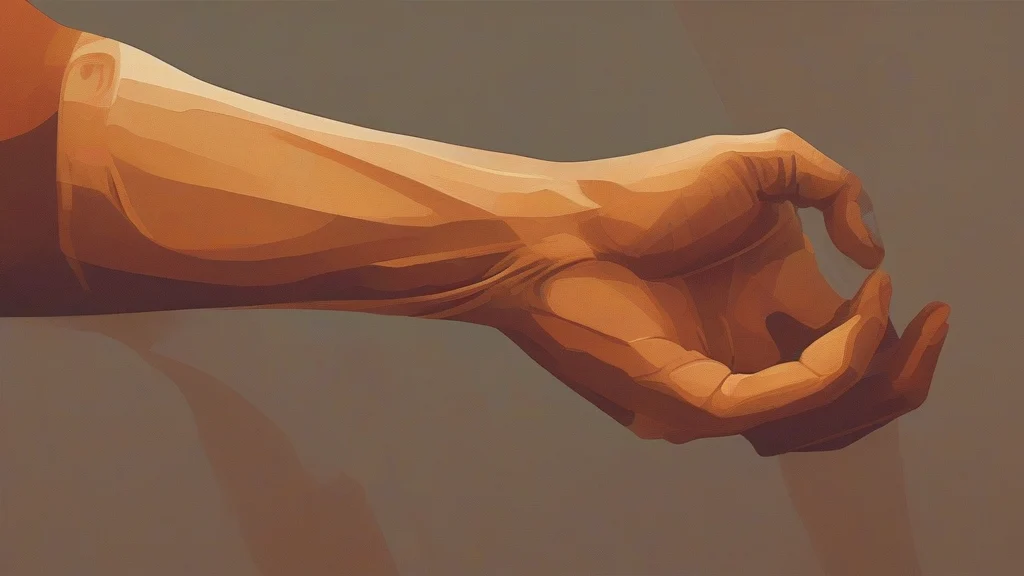
What does arm mean?
An arm is each of the two upper limbs of the human body, running from the shoulder to the hand, and the word also describes similar limbs on other animals. By natural extension, it names any long, slender, projecting part of a thing: the arm of a chair, the arm of a crane, or the arm of a record player. In its plural form, 'arms' carries a distinct second meaning — weapons and military equipment — which gives English expressions like 'the arms race', 'a call to arms', and 'the armed forces'. The word can also denote a branch or division of something larger, such as the administrative arm of a government, and figuratively suggests reach or power, as in 'the long arm of the law'. Derived forms include 'armed' (equipped or carrying weapons), 'disarm', 'rearm', 'armful', and 'armpit'. Common idioms include 'arm in arm', describing linked companionship, and 'with open arms', expressing warm welcome.
Either of the two upper limbs of the human body, from the shoulder to the hand.
"She rolled up her sleeves and got to work, baring both arms."
Also applied to corresponding limbs of animals and to long projecting parts of objects.
To equip with weapons; more broadly, to prepare or provide someone or something with the means to act or defend themselves.
"The soldiers were ordered to arm themselves before dawn."
Often used figuratively, e.g. 'arm yourself with facts before the debate'.
In the abstract or collective sense, 'arms' usually refers to weapons rather than limbs, as in 'small arms' or 'the right to bear arms'.
"The treaty aimed to reduce nuclear arms across both nations."
The word 'arm' comes from the same Latin root as 'armada' and 'armor' — because in Latin 'armus' meant shoulder, the very joint that makes throwing weapons possible.
Reviewed by Deb Chak, Editor. AI-assisted content curated by RJS Tech Solutions LLP.
Etymology of arm
The English noun 'arm' descends from Old English 'earm', which itself traces back through Proto-Germanic to the same Indo-European root as Latin 'armus', meaning the shoulder or uppermost part of the forelimb. This shared origin explains why so many words relating to weaponry carry the same root: Latin 'arma' ('weapons, armor') gave rise to 'armor', 'armory', 'armada', and 'armistice'. The verb sense 'to arm' — to equip with weapons — entered Middle English from Old French 'armer', derived ultimately from the same Latin source. Thus the everyday word for a body part and the language of warfare are, quite literally, related at the root.
Related word forms
How arm is actually used
As a noun, 'arm' is common in everyday speech with no register constraints. The plural 'arms' almost always means weapons rather than limbs when used abstractly (as in 'the arms trade' or 'a call to arms'), so context determines meaning. The verb 'to arm' is standard and unmarked.
Easily confused with arm
'Harm' means damage or injury, while 'arm' refers to a limb or a weapon — they rhyme but differ in meaning entirely.