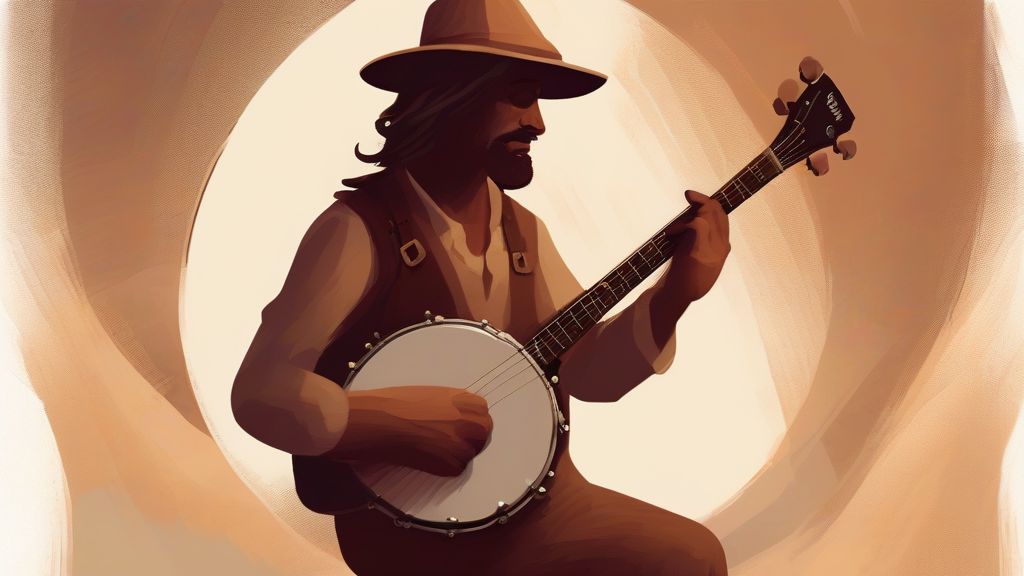
What does banjo mean?
A banjo is a stringed musical instrument consisting of a circular body covered with a stretched membrane or skin — historically animal hide, now often synthetic — attached to a long fretted neck bearing four or five strings. Played by plucking or strumming, it produces a bright, percussive, instantly recognizable twang that cuts through an ensemble. The banjo is foundational to several American musical traditions: it drives bluegrass and old-time music, features prominently in folk, country, and Dixieland jazz, and has a rich history rooted in African instruments brought to the Americas by enslaved people before being adopted and transformed in nineteenth-century America. Different playing styles — such as clawhammer and three-finger picking — produce markedly different textures. The word itself derives from terms like 'banjar' recorded in the Caribbean and colonial America in the seventeenth century. Today the banjo symbolizes both Appalachian heritage and, more broadly, the blending of African and European musical influences into distinctively American forms.
nounA stringed musical instrument with a circular body, a fretted neck, and typically four or five strings, played by plucking or strumming; it has a distinctive bright, twangy tone and is central to folk, bluegrass, and old-time American music.
- The five-string or four-string plucked instrument of the guitar family, central to American folk and bluegrass music.
"She picked up her banjo and led the band through a rollicking bluegrass tune."
"He taught himself to play the banjo from online videos."
"The bluegrass band's driving sound was anchored by a rolling banjo line."
The standard plural is 'banjos'. An older variant 'banjoes' appears in some historical texts, but 'banjos' is now the universally accepted form.
"Both banjos were tuned to open G for the performance."
The banjo was born from African instruments enslaved people brought to America — making one of country music's most iconic instruments, at its roots, African.
Reviewed by Deb Chak, Editor. AI-assisted content curated by RJS Tech Solutions LLP.
Etymology of banjo
The word 'banjo' developed in the American South during the eighteenth century from earlier terms such as 'banjar' and 'banger', which were recorded in the Caribbean and colonial North America by the mid-seventeenth century. These terms themselves derive from West African instruments — likely related to the akonting of Senegambia and similar gourd lutes — brought to the Americas by enslaved Africans. The English term may also show influence from 'bandore' and related European words ultimately tracing back through Portuguese and Spanish to Greek 'pandoura'. By the early nineteenth century 'banjo' had become the standard English name for the instrument as we now know it.
How banjo is actually used
Plural is 'banjos' — unlike many musical-instrument names ending in -o (e.g. 'cellos', 'pianos'), some older sources used 'banjoes', but modern standard usage is overwhelmingly 'banjos'. The word carries warm, folksy connotations in American culture.
Easily confused with banjo
A banjolele is a hybrid instrument combining a banjo body with a ukulele-sized neck, whereas a banjo is the full standard instrument, typically with four or five strings.