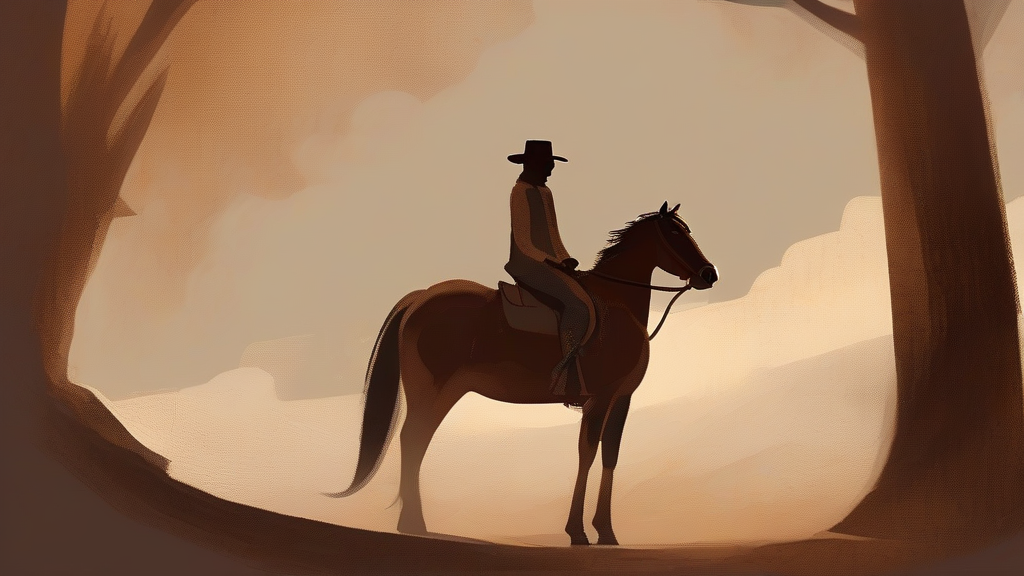
What does barebacked mean?
"Barebacked" describes someone riding a horse without a saddle, seated directly on the animal's back, or an animal carrying no saddle. The word combines "bare," meaning uncovered or unprotected, with "backed," referring to the back of the horse. It is most often encountered in equestrian, historical, and circus contexts, where riders demonstrate balance and skill by dispensing with tack. Although closely related to the more common term "bareback" — which functions as an adverb or noun in modern English — "barebacked" serves specifically as an adjective, characterizing the rider or the horse itself. The word carries connotations of daring, tradition, and closeness to the animal, evoking images of children on ponies, circus acrobats, and riders in cultures where saddles were not used. While it has been partly superseded by "bareback" in everyday speech, it remains a vivid and precise descriptor wherever the absence of a saddle is worth noting.
adjectiveRiding a horse without a saddle; more broadly, doing something without the usual protective equipment or support.
- (Of a rider) not using a saddle; riding on a horse's bare back.
- (Of an animal) having no saddle on its back.
"The cowboys rode barebacked across the open range, their knees gripping the horses' flanks."
"She learned to ride barebacked as a child, balancing easily on her pony's smooth back."
"In the circus act, a barebacked performer leapt between two galloping horses."
Before saddles spread across Europe, every rider was a barebacked rider — the word preserves one of humanity's oldest ways of getting around.
Reviewed by Deb Chak, Editor. AI-assisted content curated by RJS Tech Solutions LLP.
Etymology of barebacked
"Barebacked" is formed within English from "bare," an Old English adjective meaning uncovered or naked, combined with "backed," referring to the back. The compound follows a pattern seen in other English adjectives such as "barefoot" and "bareheaded." Its use grew alongside equestrian culture, describing riders who mounted without a saddle — a practice far older than the word itself, since saddles were adopted gradually across Europe after antiquity. The related term "bareback" emerged later and has become the dominant form in modern usage.
Related word forms
How barebacked is actually used
The adjective "barebacked" is less common than the adverb/noun "bareback," which is now the standard term in equestrian contexts. "Barebacked" is chiefly used to describe the rider rather than the manner of riding. In modern usage, "bareback" alone has largely absorbed both functions, so "barebacked" appears mostly in older texts and descriptive writing.
Easily confused with barebacked
"Bareback" is typically an adverb or noun describing riding without a saddle, while "barebacked" is the adjective form describing a person or animal as being without a saddle.