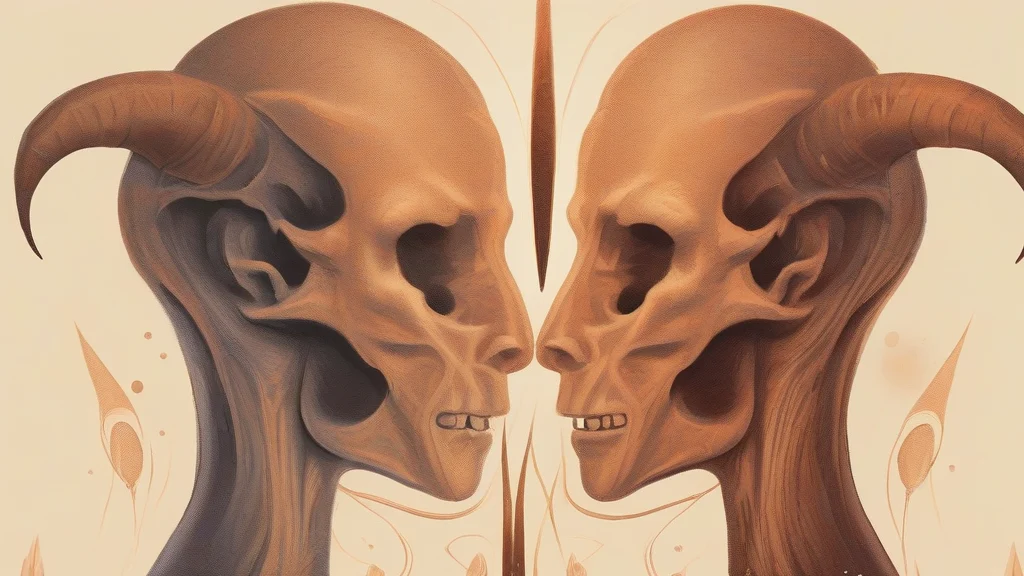
What does bicornuate mean?
Bicornuate is a technical adjective meaning 'having two horns or horn-like projections.' Its dominant use today is in anatomy and reproductive medicine, where a bicornuate uterus refers to a womb shaped partly like two horns because the paired embryonic ducts that normally fuse into one cavity have merged incompletely. This congenital variation is often asymptomatic and frequently discovered only during imaging, though it can be associated with certain pregnancy considerations, which makes accurate diagnosis important. Beyond medicine, the word appears occasionally in zoology to describe animals bearing paired horn-shaped structures, such as certain beetles. Formed from the Latin bi- ('two') and cornu ('horn'), bicornuate belongs to a small family of English terms built on that root, alongside unicorn and cornea. It is a formal, precise term: readers will encounter it almost exclusively in clinical reports, textbooks, and scientific literature rather than casual speech.
adjectiveHaving two horns or horn-like projections. In medicine, most commonly describing a uterus that is divided into two partial cavities by a partial failure of fusion during embryonic development.
- (Anatomy) Describing a uterus divided into two horn-like cavities due to incomplete fusion of the Müllerian ducts during fetal development.
- (General/Zoology) Having two horns or horn-like projections.
"The ultrasound revealed a bicornuate uterus, which the obstetrician explained is a congenital variation."
"A bicornuate uterus is usually discovered incidentally during imaging rather than through symptoms."
"Some beetles bear strikingly bicornuate head structures used in combat with rivals."
The same Latin root for 'horn' that names the mythical unicorn also describes a very real anatomical shape — and about 1 in 200 women have a bicornuate uterus without ever knowing it.
Reviewed by Deb Chak, Editor. AI-assisted content curated by RJS Tech Solutions LLP.
Etymology of bicornuate
Bicornuate derives from New Latin bicornuatus, built on the Latin elements bi- ('two') and cornu ('horn'), the latter also giving English words such as unicorn, cornea, and coronet. The term entered scientific usage as anatomists adopted Latinized descriptive vocabulary for bodily forms. Its closest relatives are other bi- compounds such as bicorn and bicorne, which describe two-horned shapes in heraldry and zoology.
How bicornuate is actually used
Predominantly a technical term found in medical, veterinary, and zoological writing; rare in everyday conversation. It is an adjective and does not inflect for plural. The related form 'bicornate' exists as a variant but 'bicornuate' is the standard spelling in modern medical usage.
Easily confused with bicornuate
A unicorn has a single horn (Latin uni- 'one' plus cornu), while bicornuate describes something with two horn-like parts.