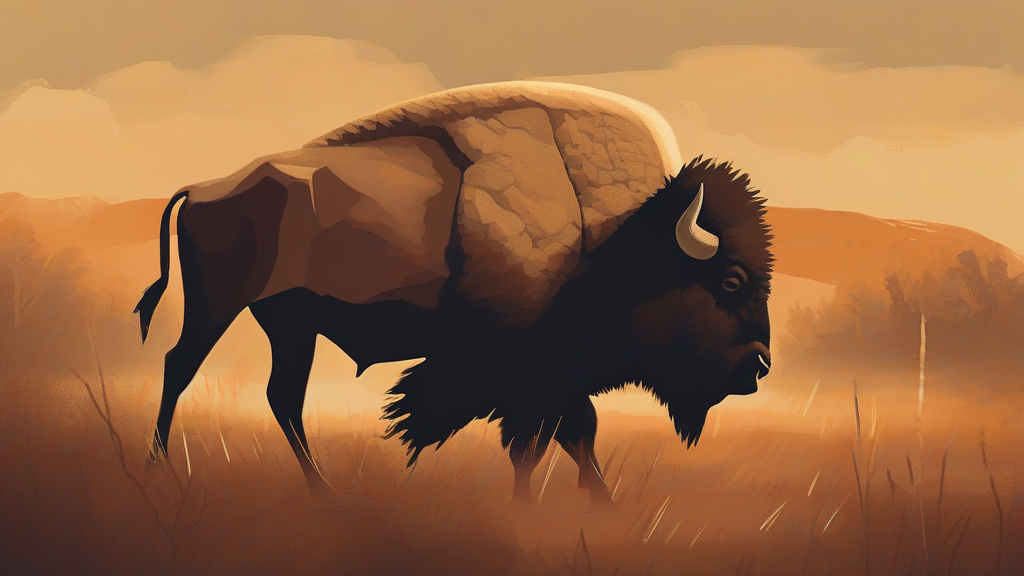
What does bisontine mean?
'Bisontine' is a rare formal adjective meaning of or relating to the bison, or resembling one in form or manner. It belongs to the same learned family of animal-derived adjectives as bovine, leonine, and feline, formed with the Latinate suffix '-ine'. In practice it appears most often in zoology, natural history, and literary description: writers might refer to bisontine herds on the Pleistocene steppe, bisontine imagery in Paleolithic cave art, or, figuratively, a person's bisontine bulk and shaggy bearing. Because it names an animal rather than evoking temperament, it lacks the pejorative shading that 'bovine' sometimes acquires. The word is uncommon enough that many readers will meet it only occasionally, which makes it useful precisely when a writer wants precision and a touch of the exotic rather than plain phrasing.
adjectiveOf, relating to, or characteristic of the bison; resembling or suggestive of a bison.
- Of, belonging to, or characteristic of the bison (genus Bison).
- Resembling or suggestive of a bison in appearance, bulk, or character.
"The museum's bisontine exhibits traced the animal's central role in Plains Indian life."
"The cave painters of Altamira captured bisontine forms with astonishing vitality."
"He was a heavyset man with a bisontine shag of hair across his brow."
A single herd of bisontine proportions once darkened the American plains for days at a time — this rare word exists purely to describe such giants.
Reviewed by Deb Chak, Editor. AI-assisted content curated by RJS Tech Solutions LLP.
Etymology of bisontine
'Bisontine' derives from 'bison', a noun English took from Latin bisont-, bison, denoting the European wild ox; Latin likely borrowed the word itself from Germanic sources. Combined with the Latin adjectival suffix '-inus' (English '-ine'), it literally means 'of the bison'. Its closest relatives are therefore the noun 'bison' and the parallel set of '-ine' animal adjectives such as bovine and taurine.
How bisontine is actually used
'Bisontine' is a rare, learned adjective found chiefly in zoological writing and elevated literary prose; it carries no negative connotation, unlike 'bovine', which can suggest dullness.
Easily confused with bisontine
While 'bovine' refers generally to cattle and oxen and often suggests sluggishness, 'bisontine' specifically denotes the bison.
'Byzantine' means intricate, devious, or relating to Byzantium, whereas 'bisontine' relates simply to bison — they share little beyond a similar sound.