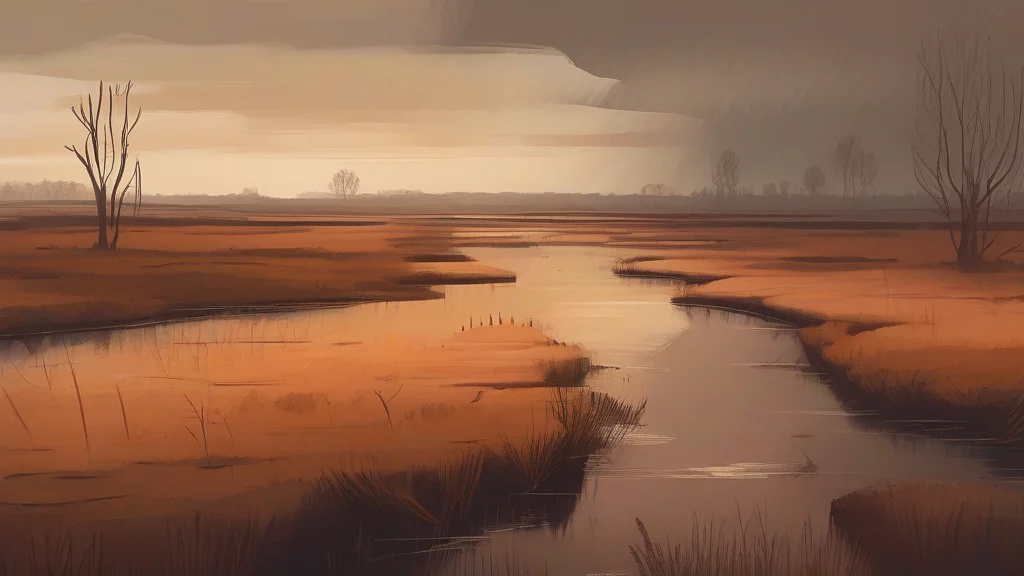
What does bogland mean?
Bogland is land made up of bog — waterlogged ground in which dead vegetation accumulates as peat because the waterlogged conditions prevent it from fully decomposing. Typically acidic and nutrient-poor, bogland supports distinctive plant life such as sphagnum moss, heather and cotton-grass, and can preserve organic material, including ancient wooden artefacts and human remains, for thousands of years. The word is used most often in connection with Ireland, Scotland and northern Europe, where great tracts of raised and blanket bog once dominated the landscape and were traditionally cut for peat fuel. In literature, notably in the poetry of Seamus Heaney, bogland has taken on a figurative charge: a storehouse of buried history and collective memory. While close in meaning to terms like peatland or wetland, it remains the natural choice when describing actual bog terrain, whether ecologically, agriculturally, or poetically.
nounLand consisting of or covered by bog, especially an extensive tract of waterlogged, peat-forming ground.
- A tract of land consisting of bog or peat-covered ground.
"The road wound through mile after mile of silent bogland."
"Farmers once cut turf by hand across the open bogland."
"Conservationists are working to restore the damaged bogland to its natural, waterlogged state."
The plural is uncommon; writers usually refer to 'areas of bogland' or use mass-noun phrasing instead.
"Several distinct boglands survive within the national park."
Seamus Heaney made 'bogland' a byword for Ireland itself, calling the country a place where history lies preserved in its bogs like bodies kept for centuries in the peat.
Reviewed by Deb Chak, Editor. AI-assisted content curated by RJS Tech Solutions LLP.
Etymology of bogland
The word combines 'bog', borrowed into English from Irish and Scottish Gaelic 'bogach' (soft, marshy ground), with the native English suffix '-land'. The Gaelic root ultimately relates to 'bog' meaning 'soft'. The compound arose naturally in Hiberno-English usage to describe the extensive peat bogs of Ireland, and it entered wider English largely through Irish writing and geography.
How bogland is actually used
Bogland carries strong associations with Ireland and parts of Britain, where it evokes both bleakness and deep cultural memory; it can sound literary or regional rather than neutral-scientific, in which contexts terms like peatland or blanket bog may be preferred.
Easily confused with bogland
Wetland is the broad scientific category for any water-saturated ecosystem (including marshes, swamps and fens), while bogland refers more specifically to terrain that is bog — acidic, peat-accumulating ground fed mainly by rainfall.